

HCPCS code E0198: Water pressure pad billing guide
HCPCS code E0198 is a water pad for a standard mattress HCPCS code E0198 is the ...

Last Updated: Oct 13, 2026
A4270 is the HCPCS Level II code for a disposable endoscope sheath, billed one unit per sheath.
Medicare pays it under the DMEPOS fee schedule, so the supplier billing it must hold DMEPOS enrollment with the applicable DME MAC. Two coding errors account for most of the rest. Some bundle the sheath into the endoscopy CPT when it should stand alone. Others reach for a miscellaneous supply code that a specific descriptor already covers.
Let Pabau's smart automation suggest the right codes, reduce claim denials, and keep your practice compliant—effortlessly.
Automate repetitive tasks and focus on what matters most—your patients.
Reduce coding errors and ensure compliance with the latest regulations.
Clean claims, fewer denials, and faster reimbursements.
Powerful insights and reporting to help your practice thrive.
HIPAA compliant SOC 2 certified GDPR-compliant Trusted by 4,000+ clinics worldwide

HCPCS code A4270 covers one disposable endoscope sheath per procedure, not a kit and not a reusable cover.
Medicare pays A4270 under the DMEPOS fee schedule, so the billing supplier must hold DMEPOS enrollment.
An NCCI edit denies A4270 whenever the endoscopy CPT already pays for disposable supplies.
Modifier KX is required once every coverage criterion is documented, and GA or GY cover the denial scenarios.
Claims management software like Pabau flags a missing modifier or an incomplete file before the claim is submitted.
HCPCS code A4270 carries the official descriptor “Disposable endoscope sheath, each” in the CMS HCPCS Level II code set. It belongs to the A-series, which covers transportation services and medical and surgical supplies. The “each” unit of service means one claim line equals one sheath used during one procedure session.
The code sits within the broader DMEPOS category for billing purposes, short for Durable Medical Equipment, Prosthetics, Orthotics, and Supplies. That classification decides who may bill it.
The supplier submitting A4270 must be enrolled as a DMEPOS supplier with the applicable Medicare Administrative Contractor, not merely as a physician or facility. Practices that bill A4270 under a physician NPI without DMEPOS enrollment receive an automatic denial.
A4270 covers a single-use, disposable protective sheath placed over a flexible endoscope before a procedure. The sheath allows the scope to be reused across patients without full reprocessing between cases, which supports infection control protocols. Coverage is per unit, so two sheaths used in one session may be billed as two units where the documentation accounts for both.
The code does not cover every supply associated with an endoscopy. Verify whether the sheath is already included in a separately billed procedure kit before submitting A4270 alongside another supply code for the same session.
A4270 applies wherever a single-use sheath is placed over a flexible endoscope so the scope can be reused between patients. Common procedures include flexible nasolaryngoscopy, bronchoscopy for pulmonary evaluation, and upper GI endoscopy. The sheath is the infection-control mechanism that removes the need for chemical reprocessing between consecutive patients.
The physician’s order must reflect the clinical indication for the procedure itself, and the procedure note should confirm that a single-use sheath was applied. Practices running high-volume endoscopy schedules bill A4270 most often, particularly in ENT, pulmonology, and gastroenterology.
Medicare Part B covers A4270 under the DMEPOS benefit when medical necessity is established and the supplier is properly enrolled. DMEPOS claims go to the DME MAC for the supplier’s jurisdiction. Noridian Healthcare Solutions administers DME Jurisdictions A and D, and CGS Administrators handles DME Jurisdictions B and C.
Each DME MAC publishes its own Local Coverage Determination or policy article, which can add coverage criteria on top of the national rules. Confirm the applicable LCD before the claim is built.
Commercial payers and Medicaid programs vary widely. Many follow Medicare’s lead on DMEPOS supply coverage, while others require prior authorization or impose quantity limits. Verifying benefits at the procedure level stops a retroactive denial on a supply line that pays only a few dollars.
A4270 is reimbursed under the CMS DMEPOS fee schedule, and payment rates vary by jurisdiction. CMS publishes the schedule each October for the following calendar year. Pull current figures from the CMS Physician and DMEPOS fee schedule lookup rather than a prior-year rate sheet. Supply-code rates move every January, so a stored figure goes stale within months.
Commercial contracts typically negotiate rates as a percentage of the Medicare allowable. Practices billing A4270 in volume should benchmark their contracted rate against the current DMEPOS allowable to find underpayments. Recording the unit count and the procedure date on every claim line turns reconciliation into a month-end task.
Pull the current CMS DMEPOS fee schedule file from cms.gov, and load it into your billing system before the new plan year begins. CMS posts it as a public use file each October. Rate changes on supply codes like A4270 are easy to miss when the focus is on procedure code updates.
A4270 claims fail audits most often because the file is incomplete when the claim goes out. A DMEPOS supply code needs more supporting paperwork than a standard physician service code. Build the checklist below into the pre-billing workflow rather than assembling it after a denial arrives.
Practices using claims management software can configure pre-submission checks that flag an A4270 line with a missing attachment. The incomplete claim is caught inside the practice rather than by the payer. Records must also stay retrievable for the CMS-required retention period, which runs well past the date the claim is paid.
A4270 has no fixed list of covered ICD-10-CM codes, unlike a drug J-code. The supporting diagnosis must justify the endoscopic procedure itself, not the sheath. Payer-specific Local Coverage Determinations may restrict which diagnoses support coverage, so confirm against the applicable DME MAC policy.
Modifier selection on A4270 decides whether Medicare processes, holds, or automatically denies the claim line. The three modifiers below each carry a specific meaning that Medicare reads before adjudication.
Using KX when the coverage criteria have not been documented is a false attestation, and it creates overpayment liability. Confirm the LCD requirements are met before you append it. Modifier rules can differ from the general CMS guidance above, so verify against current DME MAC policy.
A4270 sits in a small cluster of HCPCS codes that coders misapply when the product or the scenario does not map cleanly to the descriptor. The table below shows the common confusion points and when each code is correct.
Cross-referencing an unfamiliar A-series code against the AAPC HCPCS code lookup and the NLM HCPCS Level II search API keeps the claim file defensible. Do that before defaulting to a miscellaneous code.
CMS National Correct Coding Initiative (NCCI) edits define which service combinations may not be billed together on the same date of service. For A4270, the question is whether the sheath cost already sits inside the global payment for the associated endoscopy CPT code.
Where an endoscopy CPT bundles all disposable supplies into its relative value units, billing A4270 separately on the same claim triggers an NCCI bundling edit. The edit applies when the sheath counts as an integral part of the procedure rather than a separately identifiable supply.
When A4270 is genuinely an add-on supply beyond what the global payment covers, it may be billed separately. The procedure note then has to substantiate that the sheath was an additional, separately identifiable item. Verify the specific edit pairs against the current CMS NCCI table using the PGM Billing HCPCS lookup tool.
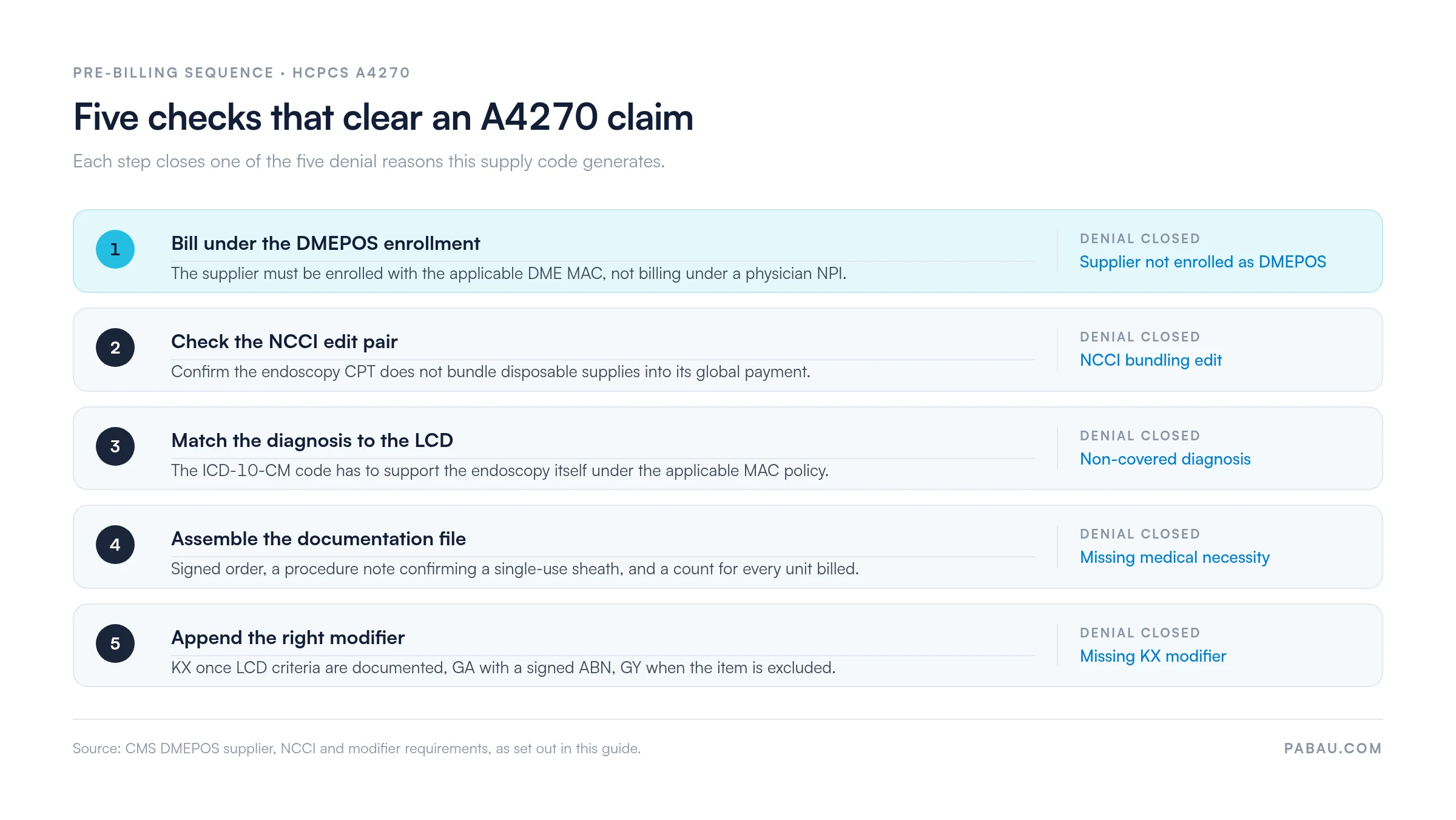
A4270 denials cluster around five root causes, and a pre-billing checklist prevents most of them. Mapping every returned claim back to its denial codes is the fastest way to stop the same error repeating across a billing cycle.
When a denial arrives, the CARC (Claim Adjustment Reason Code) on the remittance names the denial category. CARC 50 and CARC 4 are the two most common codes on A4270 denials.
CARC 50 means the service is not deemed a medical necessity by the payer. CARC 4 means the procedure code is inconsistent with the modifier used, or that a required modifier is missing. Both are appealable once the documentation file is complete, and submitting a clean claim removes the scenario altogether.
The five checks below run in the order the claim is assembled, and each one closes a specific denial reason.
Medicare does not include A4270 in its DMEPOS prior authorization program, which targets higher-cost durable equipment. No Medicare prior authorization requirement attaches to this code.
Commercial payers are a different matter. Some plans require prior authorization for procedure-associated supply codes. That is most common when the claim value passes a threshold, or when the procedure itself needs authorization. Confirm the payer’s supply-code policy before the procedure date.
Set up a payer-specific prior authorization reference sheet for each commercial payer that covers your endoscopy patient volume. Update it at each contract renewal. A4270 is low-cost per unit but high-volume in endoscopy-heavy practices, so an undiscovered PA requirement can generate significant write-offs.
Most billing teams find an A4270 problem after the remittance arrives. The supplier enrollment was wrong, the KX modifier was left off, or the procedure note never confirmed a single-use sheath. By then the claim is already in the denial queue.
Practice management software like Pabau moves that check to the front of the process. Claim rules run against the coded line before submission. A missing modifier or an unsigned order stops the claim inside the practice. Documentation lives on the patient record, so the procedure note supporting the sheath sits on the same encounter the claim bills.
For an ENT or pulmonology practice running a full endoscopy list, that changes the economics of a low-value supply code. Chasing a denial on a small supply line costs more in staff time than the line pays, so the fix has to happen before submission.

Pabau’s claims management software lets you build pre-submission rules that catch missing modifiers, incomplete documentation, and DMEPOS enrollment mismatches before a claim leaves your system.

A4270 is a simple supply code made complicated by DMEPOS enrollment, modifier precision, and NCCI edits that shift with the procedure CPT. The practices that bill it cleanly build the documentation checklist into the procedure workflow, not into the appeal.
One denied sheath is rarely worth an appeal. A weekly endoscopy list turns the same error into a recurring write-off, which is what makes the pre-billing checks worth the setup time.
Fix the workflow once and the unit value stops mattering. Book a demo to see how Pabau catches a missing KX modifier or an unsigned order before an A4270 claim reaches the DME MAC.

List Item #1
List Item #2
HCPCS code A4270 covers a single disposable endoscope sheath used during a flexible endoscopic procedure. It is billed per unit (“each”) and applies only to single-use sheaths. Reusable covers, and sheaths bundled into a separately billed procedure kit, are not covered under this code.
Yes. Medicare Part B covers A4270 under the DMEPOS fee schedule when medical necessity is documented. The billing supplier must also be enrolled as a DMEPOS supplier with the applicable DME MAC. Claims submitted under a physician NPI without DMEPOS enrollment are automatically denied.
Three modifiers cover almost every A4270 line. KX says the coverage criteria are met, and it is the standard choice. GA says an ABN is on file because the item may be denied. GY says the item is statutorily excluded, which generates the denial a secondary payer needs. Incorrect modifier use creates overpayment liability, so verify current DME MAC policy first.
Medicare does not currently require prior authorization for A4270. Commercial payers vary. Some plans require it for procedure-associated supply codes, or when the endoscopy itself needs authorization. Confirm payer-specific requirements before the procedure date.
It depends on whether the endoscopy CPT bundles disposable supply costs into the global procedure payment. Where an NCCI edit bundles the sheath into the CPT, A4270 cannot be billed separately on the same date. Where the sheath falls outside the global payment, it can be billed alongside the CPT with supporting documentation.
Five causes account for most of them. The supplier is not enrolled as a DMEPOS supplier. The KX modifier is missing although the coverage criteria are met. An NCCI edit bundles the sheath into the endoscopy CPT. The ICD-10 diagnosis is not covered under the LCD. The procedure note never confirms that a single-use sheath was applied.



