Physician credentialing checklist
A physician credentialing checklist lists every license, certificate, verificati...

Last Updated: Oct 23, 2026

Phase 1 runs for two weeks and cuts all fruit, bread, pasta, alcohol, and added sugar to settle sugar cravings.
You can eat lean protein, non-starchy vegetables, low-fat dairy, eggs, nuts, and olive oil in measured portions.
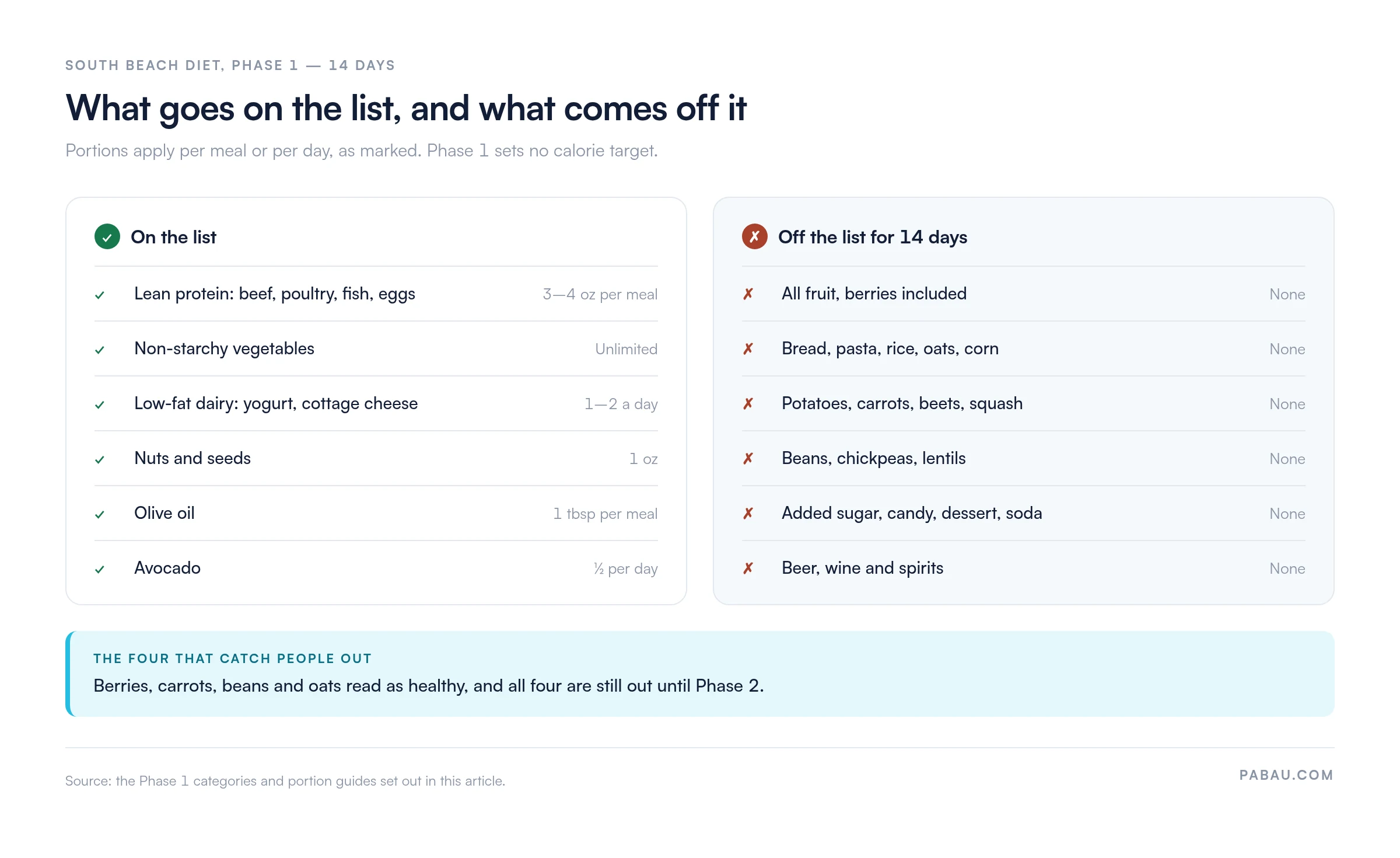
Legumes, carrots, oats, and berries stay out until Phase 2, even though all four sound compliant.
Dr. Agatston’s published estimate for the two weeks is 8 to 13 pounds, and Phase 1 sets no calorie target.
The free download above carries the categorized food list, a grocery checklist by aisle, and a 7-day meal plan.
Two printable pages. Page one lists every Phase 1 food group with its portion guide, plus the seven banned categories. Page two is a grocery checklist by aisle and a 7-day meal plan.
Download templateThe South Beach Diet Phase 1 food list is short on purpose. For two weeks you eat lean protein, non-starchy vegetables, low-fat dairy, nuts, and olive oil, and very little else. No fruit, no bread, no pasta, no alcohol.
Cardiologist Dr. Arthur Agatston designed the phase to settle sugar cravings before you start adding carbohydrates back.
The catch is that several foods people assume are fine, like berries, carrots, and beans, are still out. Get that part wrong and you spend two weeks stalled. Below you will find the full list by category, a grocery checklist, a 7-day meal plan, and the traps to sidestep.
Phase 1 runs for exactly two weeks, and then it ends. That time limit is the design rather than a suggestion. Cutting refined carbohydrates steadies your blood sugar, and steadier blood sugar quiets the hunger spikes that usually end a diet in week one.
Agatston built the program around food quality instead of calorie math. That is why South Beach leans on lean protein, unsaturated fats, and vegetables rather than a daily number. The same thinking runs through any heart healthy diet plan.
Most people finish the two weeks with fewer cravings and visible progress, and that momentum is what carries them into Phase 2. So treat Phase 1 as a reset, not a way of eating forever.
Four groups make up the whole of Phase 1: protein, non-starchy vegetables, low-fat dairy, and fats. Portions matter more than variety here, so read the guides below as per meal or per day.
If you want more protein ideas across a full week, a high protein meal plan covers similar ground with more recipes.
The cut matters more than the animal. Extra-lean is the standard, so 95% lean ground beef is in and a ribeye is not.
These are the only Phase 1 foods with no portion cap, so lean on them whenever a meal feels light.
Fat is allowed, but the portions are small and easy to overshoot. Measure the oil with a spoon for the first few days.
Phase 1 removes seven whole categories, and the aim is to reset what tastes sweet to you. Going strict is easier than going partial here. A little fruit or one slice of bread keeps the craving cycle running, which defeats the two weeks.
Side by side, the two lists are easier to keep straight, especially the four foods that look compliant and are not.
Shop the perimeter of the store first. Produce, then the meat and fish counter, then dairy, with pantry items last. That order keeps you out of the aisles where the banned categories live.
Here is a full week that stays inside the list. Rotate the proteins and vegetables so day five does not taste like day one, and scale the portions to your appetite.
For a longer runway once the two weeks are done, a 30-day meal plan picks up where this leaves off.
Snacks are allowed, and the rule matches the one for meals. Pair protein with a healthy fat, and skip the carbohydrates.
Two habits keep snacking from undoing the phase. Eat one when you are genuinely hungry rather than on a schedule. Then finish a few hours before bed, so a late snack does not become a second dinner.
Most of Phase 1 is decided before day one. Spend an hour on these five jobs and the first week stops being a run of small decisions.
One thing you do not need is a calorie tracker. Phase 1 sets no calorie target, and Agatston never asks you to count.
Published sample Phase 1 days land near 1,600 calories, which is a result of the portions rather than a rule. If you would rather work to a number, a 1,200 calorie diet plan takes the opposite approach.
Four problems come up again and again, and willpower is not one of them.
None of this calls for an app or a spreadsheet. A note on your phone listing what you ate is enough to spot the pattern behind a craving. It takes about 20 seconds a meal.
Phase 2 starts on day 15, and carbohydrates return one at a time. Low-glycemic options come first: berries, whole grains, and the legumes Phase 1 left out. Refined carbohydrates stay off the list.
Reintroducing them slowly is the point. Adding one food at a time shows you which carbohydrates restart your cravings and which ones you can live with. That personal threshold is what you carry out of the program, long after the two weeks are over.
Phase 1 works best for people fighting strong sugar cravings, and for anyone managing prediabetes or insulin resistance. Cutting carbohydrates quickly breaks the craving cycle those conditions feed.
It may be a struggle if you are vegetarian, because the protein list is mostly meat and fish. The same holds for anyone with gallbladder disease, given the fat content, or a history of disordered eating, given the strict rules.
It tends to suit people who want a clear framework with an end date. Seeing progress inside two weeks keeps them going. The program came from a cardiologist, so the food choices are heart-friendly. Even so, check with your doctor first if you manage a medical condition.
If you hand this list to patients for a living, the two weeks are only as good as the follow-up. Most practices print the food list, book a review for day 14, and hope the patient holds the line in between.
Practice management software like Pabau removes that guesswork. You send the Phase 1 food list and a starting questionnaire as digital forms before the first appointment.
The answers land straight in the patient’s record. Weight, measurements, and treatment notes then sit in the same file, so a day-14 review takes a minute instead of a hunt through paper.
Automated messages do the chasing for you. Three go out: a nudge on day three, a check-in after week one, and a Phase 2 prompt on day 15.
Purpose-built weight loss clinic software keeps those touchpoints and the patient’s results in one record. Nobody drifts out of the program unnoticed.

Pabau sends your Phase 1 food list as a digital form and logs weight against the patient record. The day-three and day-14 check-ins schedule themselves. Your team stops chasing and starts seeing which patients need help.

Phase 1 is short, strict, and finite. The job of the food list is to get you to day 15 without a detour. Treat each category as a yes or a no, and stop negotiating with the edge cases.
The part worth remembering is the end date. Phase 1 is not a way of eating. People who stretch it well past two weeks tend to rebound harder when the carbohydrates come back. Finish it, then move into Phase 2 with what you learned about your own cravings.
If you run a weight loss practice and hand out plans like this one, the follow-up is where results are won or lost. Book a demo to see how Pabau turns a printed food list into a tracked two-week program with automatic check-ins.

Want the wider low-carb picture? Low carb food list: What to eat and net carb counts gives you net carb counts per serving, which Phase 1 leaves out.
Is sugar the harder habit for you? 2 Week no sugar meal plan runs the same two-week length while keeping fruit and grains on the table.
Managing insulin resistance? Insulin resistance diet plan: Foods to eat and a weekly planner turns the same food principles into an ongoing weekly routine.
Need a shopping list you can reuse? Grocery list for weight loss covers the staples that keep working past Phase 1 and into Phase 2.
Curious how the classic low-carb plan compares? Atkins Diet Template sets out the phased structure South Beach is most often measured against.
Dr. Agatston’s published estimate is 8 to 13 pounds over the two weeks. Some of that is water, because cutting carbohydrates empties your glycogen stores. Starting weight and activity level move the number either way.
Yes. Black coffee and unsweetened tea are both fine, and a splash of low-fat milk is acceptable. Skip the sugar, honey, and syrups. Many people find the caffeine takes the edge off hunger in the first week.
Pick the list back up at your next meal. One slip does not undo two weeks, so restarting from day one is unnecessary. Repeated slips are a different matter, because they keep the sugar cravings alive.
No. Both cut carbohydrates hard, but Phase 1 lasts two weeks and then loosens up. Keto holds carbohydrates under 20 to 50 grams indefinitely. South Beach was built as a temporary reset.
Yes, and light to moderate exercise is encouraged. Walking, swimming, and strength training all fit. Save high-intensity sessions for Phase 2, when carbohydrates come back and your energy is steadier.