CRM for chiropractors: how to manage patients, bookings and marketing
A CRM for chiropractors is a patient relationship management system built around...

Last Updated: Oct 13, 2026

A paleo meal plan delivery template builds diet guidance around whole foods, and takes grains, dairy, and legumes out of the patient’s week.
The file pairs a 7-day meal structure with a grocery list, so patients leave the appointment knowing what to buy and cook.
Standard paleo and the autoimmune protocol are not interchangeable, so match the exclusion list to the patient’s clinical presentation.
Practice management software like Pabau sends the plan from the patient record, shows who opened it, and stores the follow-up answers.
A ready-to-use template with a 7-day meal structure, a grocery list with quantities, batch-prep instructions, and substitution notes. Written for dietitians, nutritionists, and practitioners who counsel patients on ancestral eating.
Download templatePatients who ask about paleo usually arrive with a search result rather than a plan.
A template turns that interest into a week they can shop for, cook, and report back on. This page covers what belongs in the file and how to hand it over so it gets used.
The download above carries the 7-day structure, the grocery list, and the prep routine. Below are the decisions the file cannot make for you. Choose standard paleo or the autoimmune protocol, work out which patients suit each one, and customize before you print.
A paleo meal plan delivery is a structured nutritional guide that a practitioner shares with a patient to support a paleolithic eating pattern. The diet centers on foods available before agriculture. That means grass-fed meat, wild-caught seafood, vegetables, fruits, nuts, and seeds, with no grains, dairy, legumes, or processed additives.
Issued as a template, it works as a clinical tool rather than a handout. The patient gets a documented starting point they can reference, adjust, and revisit across visits. That suits practitioners managing weight, metabolic health, digestive complaints, or autoimmune conditions where elimination protocols matter.
It also runs on a different rhythm from a commercial meal service. Frozen meals arrive and get eaten. A template gets used, questioned, and revised, which is the cycle below.
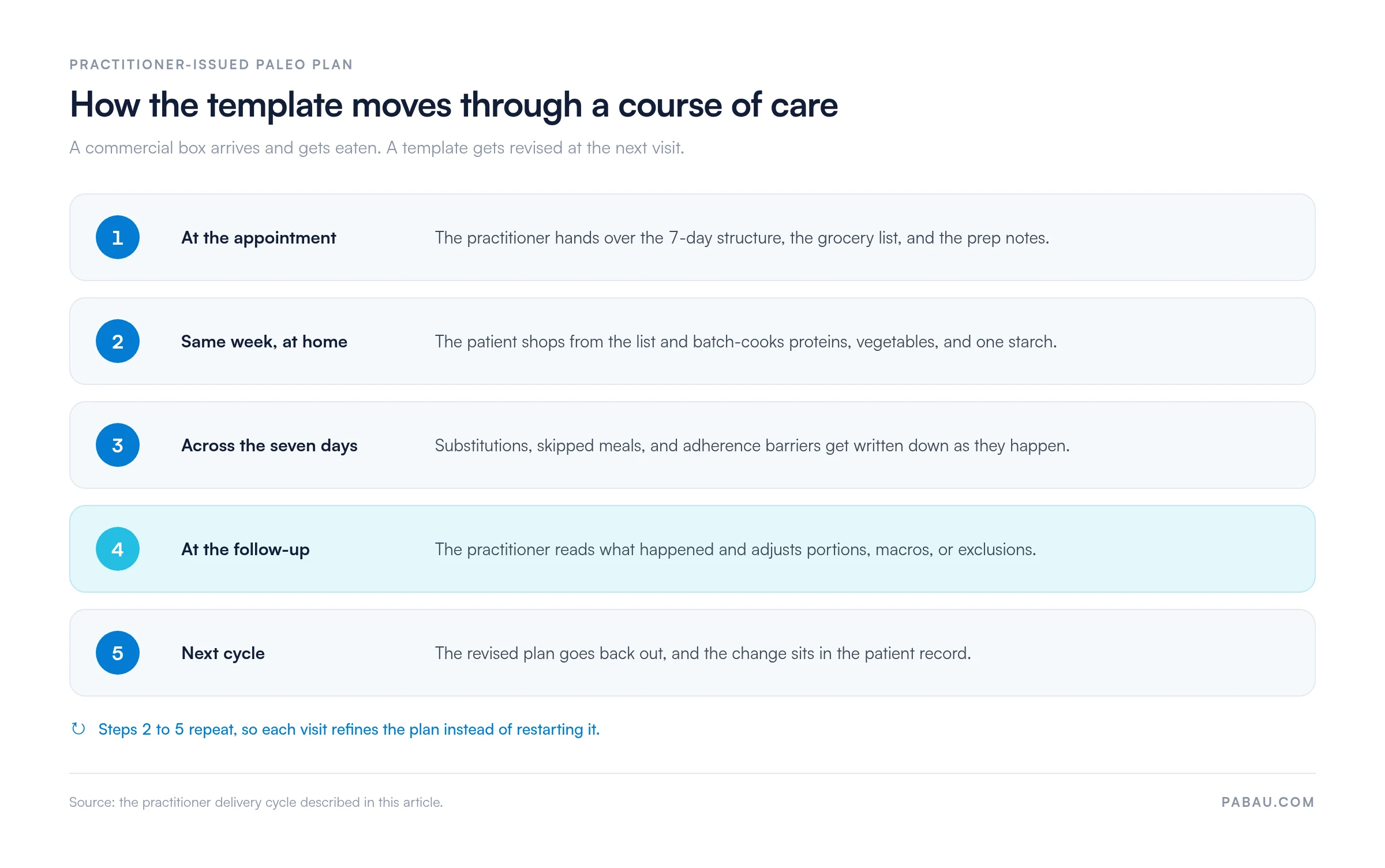
Patients take the framework home, review it, and come back with adherence questions. Each follow-up refines the plan instead of restarting it, and the changes stay documented.
The core framework covers proteins, vegetables, healthy fats, and carbohydrates from whole foods. Compliance depends on the patient knowing which foods sit on each side of that line.
This food list is the scaffolding for the rest of the file. Patients who see it in writing at the point of care know what their week looks like. Nobody has to guess whether a particular food counts.
The plan repeats a daily pattern of breakfast, lunch, dinner, and an optional snack. Seeing a full week helps patients judge meal volume, variety, and how full they will feel. Day one looks like this:
The structure varies across the seven days while the balance holds. Enough repetition makes the week feel doable, which matters more than novelty in the first fortnight. The file also carries macro notes of roughly 40% protein, 35% healthy fats, and 25% carbohydrates, so patients understand the reasoning behind the food list.
The biggest barrier to paleo is the cooking burden patients expect. Batch cooking cuts weekday effort to minutes. Here is the prep routine to walk them through:
Prep is what turns a plan into a habit. A patient who can assemble breakfast in three minutes and grab a prepared lunch will stay on the plan through a bad week. Ask them to record what they actually ate in a food diary, so the follow-up runs on notes rather than memory.
The grocery list is the part patients ask for most, and the part competing pages usually skip. Plenty of people know what to eat and still stall in the supermarket aisle. Approximate quantities help them budget and cut waste.
Handing over the list with the plan is what converts intent into a full trolley. Patients on other protocols can work from our healthy grocery list, which follows the same one-week logic.
Patients shopping for paleo meet two options. They can buy from a commercial service such as Trifecta, Sun Basket, or Paleo On The Go, or cook the week themselves. The template sits between them. It gives the structure of a meal service with the flexibility and cost of home cooking.
Services buy convenience and lose personalization. Patients on a template learn the food rules, own their shopping, and hold a plan that changes as their results do. Where cooking time is the barrier rather than the knowledge, a service for the first month can still be the right call.
A structured paleo approach is associated with weight management, lower inflammation markers, steadier blood sugar, better digestive comfort, and stronger satiety. Delivered as a template, those outcomes become measurable. Patients report changes against a written plan, your notes record adherence, and the next visit assesses what the change produced.
Standard paleo removes grains, dairy, and legumes. The autoimmune protocol goes further and also removes nightshades, eggs, nuts, and seeds. Choose between them before you print, because the stricter list carries more nutritional planning and a reintroduction phase.
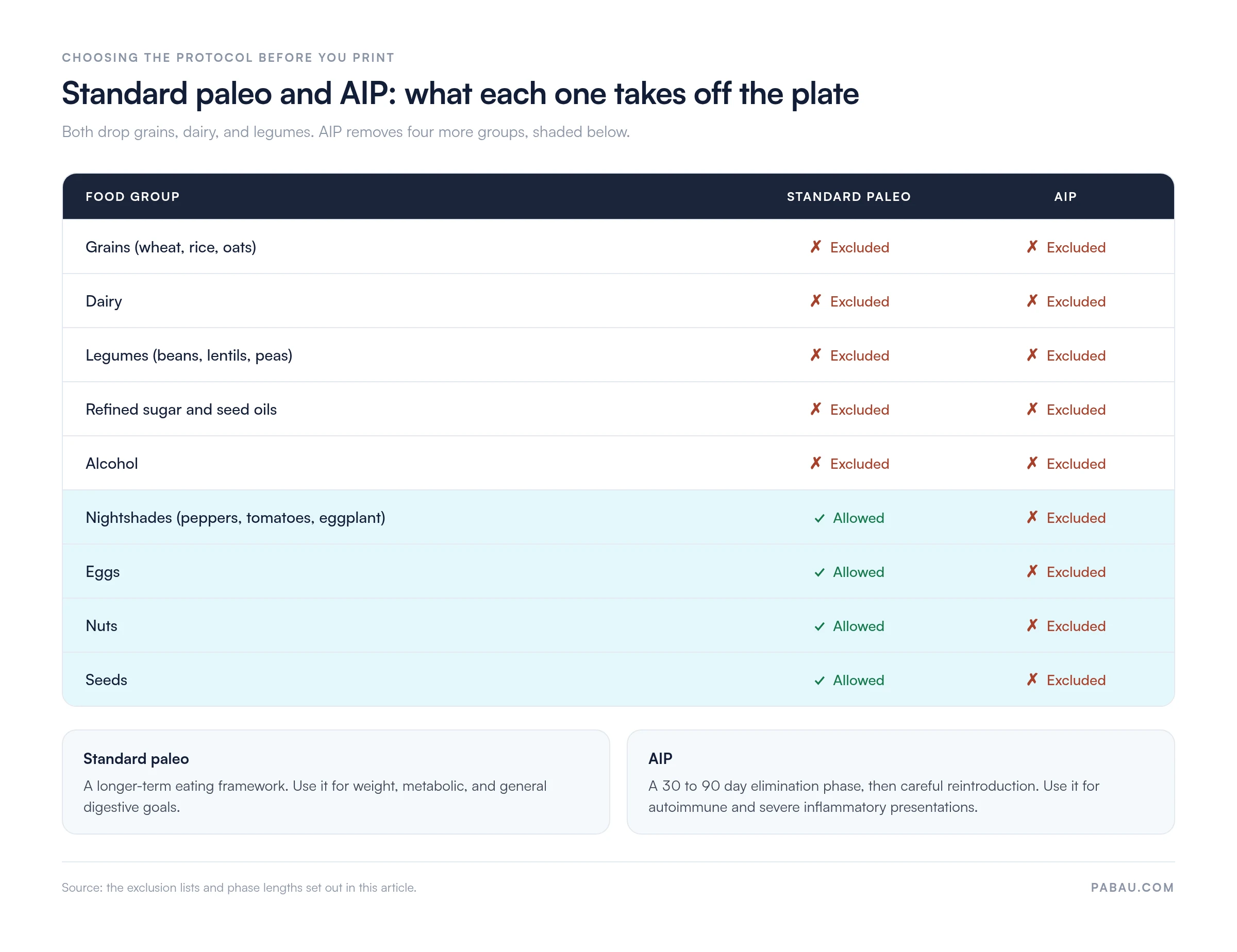
Reserve AIP for suspected autoimmune or severe inflammatory presentations, and plan the reintroduction from the start. A patient who needs a calmer diet without a full elimination phase can begin on an anti-inflammatory meal plan instead.
The template is a starting framework, not a prescription. Four adjustments cover most patients:
Make those calls with the patient’s history open in front of you. Allergies and current medications decide two of the four adjustments above.
The plan travels well across practice types, and the reason for issuing it changes with each one:
Weight loss practices run these plans alongside coaching and body composition reviews, which is the workflow weight loss clinic software is built to track. The same plan then supports the program reviews already booked in the diary.
A written plan standardizes your nutritional advice across patients and gives every follow-up a fixed reference point. It also cuts the minutes spent explaining what to eat, which is the slowest part of a nutrition consultation.
The clinical benefit is the record. A dated plan in the patient file shows what you advised, when, and what changed after it. That evidence supports the next decision far better than a recollection of the last conversation.
Eight components separate a clinical template from a magazine meal plan:
The last two are the ones most downloadable plans leave out, and they are what make the file usable in a consultation.
Most practices email the plan as an attachment and hope it gets opened. The file then lives in a sent folder rather than the patient record, so the next clinician cannot tell which version the patient is following.
Practice management software like Pabau sends the plan from the record itself. You attach the template to the client file, share it through the patient portal, and see when it was opened. Digital intake forms collect the adherence answers back into the same file.
That leaves one current plan per patient, dated, with the notes it produced attached to it. When someone returns after three months, the history is already in front of you.

Pabau lets you attach a meal plan to the client file, share it through the patient portal, and see who opened it. Adherence answers come back into the same record.

The template is worth more than the diet advice printed inside it. It gives the patient a week they can execute, and it gives you something specific to review at the next visit.
Choose the protocol before you print. Standard paleo suits weight and metabolic goals, while AIP belongs with an autoimmune or severe inflammatory presentation. Then set the calories, the exclusions, and the macros for the patient in front of you.
The trade-off worth remembering is effort. A meal service removes the cooking, a template removes the guesswork, and only one of them leaves you a record to work from. Book a demo to see how Pabau sends, tracks, and stores patient meal plans in one place.

Counseling a patient who is not ready for paleo? Nutritionist meal plan template gives you a general-purpose weekly plan to adapt to any protocol.
Need a stricter carbohydrate limit? 7-day keto meal plan covers the ketogenic version of the same weekly structure, with its own food list.
Writing up the nutrition consultation? Nutrition SOAP note gives you a documentation format for the assessment and the plan you agreed.
Running a longer weight loss program? 30-day meal plan for weight loss extends the same approach across a full month of coaching.
Comparing systems for a weight loss practice? EMR for weight loss clinics walks through what these practices need from their records software.
The paleo diet focuses on whole foods our ancestors consumed: meat, fish, vegetables, fruits, nuts, and seeds. It eliminates grains, dairy, legumes, refined sugars, and processed foods. The framework assumes ancestral eating patterns supported optimal human health and that modern ultra-processed foods drive chronic disease.
Paleo meal delivery is valuable when aligned with a patient’s health goals and guided by a practitioner. Commercial meal services offer convenience; practitioner-issued templates offer personalization, cost-efficiency, and clinical oversight. Worth is patient-specific – those struggling with grocery shopping, meal planning, or food quality will benefit most.
A paleo meal plan can support weight loss because whole foods are typically more satiating than processed alternatives. Protein intake is higher, and calorie-dense ultra-processed foods are eliminated. Weight loss results depend on adherence and overall calorie balance – the paleo framework alone does not guarantee weight loss without caloric awareness.
Commercial paleo meal delivery services typically range from $10-16 per meal. A DIY paleo meal plan based on the template usually costs $8-12 per meal depending on protein source, organic choices, and location. Practitioner-issued templates support the DIY approach, reducing cost while maintaining clinical guidance.
Paleo excludes grains (wheat, rice, oats), dairy (milk, cheese, yogurt), and legumes (beans, lentils, peas). It also drops refined sugar, artificial sweeteners, seed oils (soy, canola), alcohol, and processed additives. Some paleo practitioners include certain foods like grass-fed butter or raw dairy – the template should clarify your clinic’s specific stance.
AIP (autoimmune protocol) is a stricter elimination diet used for autoimmune and severe inflammatory conditions. In addition to standard paleo exclusions, AIP removes nightshades, eggs, nuts, seeds, and alcohol. AIP is typically a temporary 30-90-day elimination phase followed by careful reintroduction; standard paleo is a longer-term lifestyle framework.