Anja Dodevska

Shame worksheets: 6 types and when to use each one
Shame worksheets are structured writing exercises that help patients notice, nam...

Last Updated: Nov 2, 2026
Free PDF 2 pages, print-ready Clinician-reviewed
A nonsurgical butt lift is a cosmetic procedure that reshapes and lifts the buttocks without surgery. Practitioners use injectable fillers such as Sculptra or hyaluronic acid, vacuum therapy, or energy-based skin tightening.
This free nonsurgical butt lift template is a two-page consent and medical-history form you complete with the patient before treatment. It explains the procedure’s risks, benefits and alternatives, screens for contraindications and records informed consent. What follows covers how to fill it out and the four records to add before you use it.
A ready-to-use consent and medical-history form covering risk disclosure, contraindication screening and informed-consent declarations for nonsurgical buttock enhancement.
Start from scratch, or upload this PDF or any form you already use, and Pabau's AI Form rebuilds it with tick boxes, text fields and a signature. Attach it to the treatment once, and every patient gets it on time.
AI Form rebuilds the consent, history and aftercare forms you already use. You review each one, then publish.
Patients complete forms on their phone before they arrive, so the front desk stops retyping paper.
Every signed form is versioned and attached to the treatment record, ready when you need it.
Set how long a consent stays valid. Returning patients skip forms they have already signed.
Supports HIPAA and GDPR compliance AES-256 encryption 4.8 on G2 4.7 on Capterra Trusted by 4,000+ practices worldwide

A nonsurgical butt lift template standardizes risk disclosure, contraindication screening and consent for non-invasive buttock procedures.
Sculptra and dermal fillers are not FDA-approved for buttock augmentation, so use there is off-label and must be disclosed.
Screen every patient for pregnancy, active infection at the site and other contraindications before any treatment is booked.
The form confirms consent with Yes/No questions and a checkbox, so add a signature block if your policy requires one.
Pabau, the practice management platform we build, files each completed form against the patient’s treatment record.
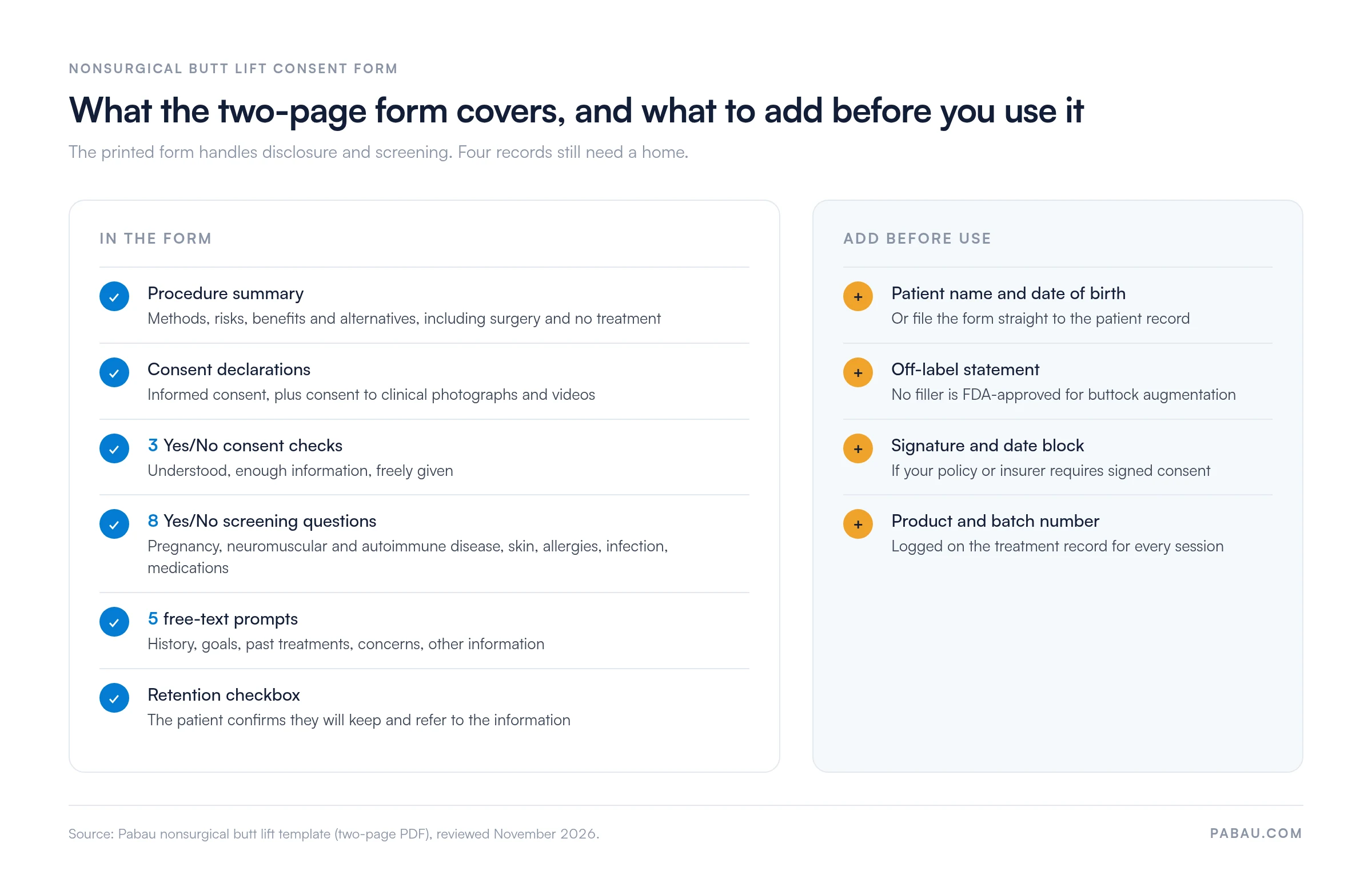
A nonsurgical butt lift template is a clinical form a practitioner completes with the patient before a non-invasive buttock treatment. It opens with a plain-language summary of the procedure, its risks, its benefits and the alternatives, including surgery and no treatment.
The rest of the form records informed consent and consent to clinical photographs. It then asks 11 Yes/No questions and five free-text questions about history, goals and concerns. It has no fields for the patient’s name, the treatment plan or signatures, so plan where those live before your first patient.
The legal context matters. Practitioners in the UK should follow the voluntary professional standards set by the Joint Council for Cosmetic Practitioners (JCCP). A mandatory licensing scheme for non-surgical cosmetic procedures in England has been proposed but is not yet in force.
Purely cosmetic filler and energy-based treatments generally fall outside the Care Quality Commission’s (CQC) regulated activities. In the US, requirements vary by state, so confirm your local scope-of-practice rules before offering the treatment.
Many nonsurgical buttock treatments use products outside their approved indications. The FDA has approved Sculptra for facial lipoatrophy and nasolabial folds, not for buttock augmentation.
The printed form doesn’t mention off-label use, so add a statement that covers it. If Sculptra is your product, a dedicated Sculptra consent form covers its own risks in more detail.
Work through the form in the order it’s laid out. Each step below mirrors a section the practitioner completes with the patient at consultation.
Keep the completed form on the patient’s record before the first treatment. A paper form filed in a back-office drawer won’t help much if a patient later disputes what they agreed to.
The form suits any practice offering non-invasive buttock treatments. It fits four kinds of practice in particular.
A standard form makes consent consistent. Every patient receives the same disclosure about risks and alternatives, which protects both the patient and the practice if the outcome is questioned later.
It also speeds up consultations. With the screening questions in a fixed order, nobody has to remember what they forgot to ask. More of the appointment goes on discussing the plan.
Finally, consistent records help during audits, complaints and insurance reviews. Anyone reading the file can see what was disclosed and what the patient confirmed.
Review the consent declarations with the patient before they tick the boxes, not after. Ask them to explain the off-label status and the main risks in their own words, then note the answer on the record. This simple step shows the patient understood the decision.
Screening is the part of the form that protects patients most. Absolute contraindications stop treatment. Relative ones need clinical judgment and often a referral or a delay.
The eight screening questions cover pregnancy or breastfeeding, neuromuscular disease, autoimmune disease, skin conditions, allergies, active infection at the site and prescription medications. A general question on medical conditions sits alongside them.
Some safety concerns are specific to buttock treatments. The American Society of Plastic Surgeons has warned publicly about illegal silicone injections. Record the source and batch number of every filler used on the treatment record.
The comparison with surgical BBL matters for patient counseling. Surgical BBL carries one of the highest mortality rates in cosmetic surgery, which is why many patients ask about non-surgical options. Present the comparison factually and avoid implying that non-surgical treatment is risk-free.
Documentation extends beyond the form itself. Record the photographs taken before treatment, the product batch numbers and any observations from the session.
The form includes consent to clinical photographs and videos, which are kept with the patient’s medical records. Check the photo consent requirements that apply to how you store and share them.
Results should be described as individual and variable. Avoid promising a specific volume, duration or outcome, and don’t present a single before-and-after image as typical.
Give patients written aftercare instructions that cover activity restrictions, swelling, when to seek help and when the follow-up appointment is due. Tie the follow-up date to the treatment record so it’s booked before the patient leaves.
On paper, this form gets printed, completed at the front desk, then scanned or filed by hand. A lost page usually goes unnoticed until a patient disputes the treatment.
In Pabau’s practice software for med spas, the form becomes a digital questionnaire. Our online booking sends it automatically once a nonsurgical butt lift consultation is confirmed.
Patients complete digital intake forms on their own phone before the visit. Each answer lands in their patient records next to treatment notes and photos, so the practitioner reviews screening answers instead of collecting them.
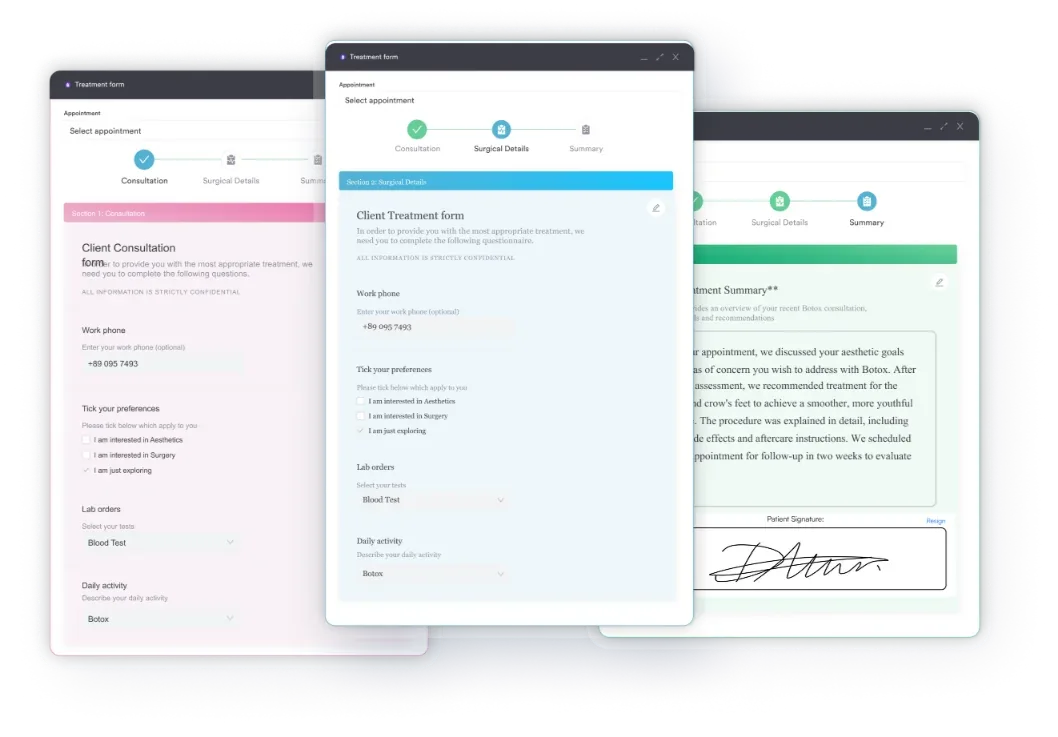

Pabau sends your nonsurgical butt lift consent form before the consultation and stores every answer on the patient record. Your team reviews screening answers instead of chasing paper.

Use this form as your baseline, but don’t use it as printed. Before your first nonsurgical butt lift patient, add an off-label statement, patient identifiers and a signature block if your policy needs one.
Do that, and every patient gets the same disclosure and the same screening. That consistency is what protects you when an outcome is questioned. The trade-off is consultation time, which is easier to find when patients complete the form before they arrive.
Book a demo to see how Pabau sends this form ahead of the consultation and files every answer on the patient record.

Offering other non-surgical lifts? Nonsurgical breast lift: Treatment options and consent form covers a sister procedure with the same off-label questions.
Working with biostimulators? Collagen stimulating injections consent form template gives you a consent form built around collagen-stimulating products.
Need written aftercare for filler patients? Dermal filler aftercare form with signature includes the signature block this form doesn’t have.
Adding body contouring to your menu? CoolSculpting consent form covers consent for fat-freezing treatments.
A nonsurgical butt lift is a non-invasive treatment that changes buttock shape and volume using injectable fillers, vacuum therapy or energy-based skin tightening. The form covers consent and screening for these procedures.
No, Sculptra is not FDA-approved for buttock augmentation. Its approved uses are facial lipoatrophy and nasolabial folds, so buttock use is off-label and should be disclosed in the consent form.
The treating practitioner should walk the patient through each consent statement and the three Yes/No consent questions. The patient then ticks the confirmation checkbox, because the form has no signature lines. Add a signature block if your policy requires signed consent.