CRM for chiropractors: how to manage patients, bookings and marketing
A CRM for chiropractors is a patient relationship management system built around...

Last Updated: Oct 13, 2026
An eye drop chart for cataract surgery is a week-by-week schedule showing which drops the patient uses, how often, and when each one stops. Most patients go home with three bottles: an antibiotic, a steroid, and a non-steroidal anti-inflammatory. Each one tapers on its own timetable across roughly four weeks, and that is where the confusion starts.
Get the taper wrong and the eye is exposed to infection, rebound inflammation, or swelling in the central retina. Spoken instructions rarely survive the drive home, so a printed chart does the remembering instead.
Below you can download the chart, read the full schedule, and pick up the handover steps that keep patients on track.
Page one carries the antibiotic, steroid and NSAID schedule, from the days before surgery to the end of week 4. Blank lines hold the patient’s own bottle names and start dates. Page two is a daily tick tracker covering all 28 days.
Download template
The chart covers three separate courses, an antibiotic, a steroid, and an NSAID, each running on its own timetable.
Drops usually start 1 to 3 days before surgery and run for four weeks afterward, with the antibiotic finishing first.
Steroid and NSAID drops step down week by week, because stopping either one abruptly can trigger rebound inflammation.
Technique decides how much drug reaches the eye, so patients need one drop at a time and five minutes between bottles.
Writing the patient’s own bottle names and dates onto the chart does more for adherence than any spoken briefing.
The drops guard against three problems at once: bacteria reaching the incision, inflammation from the surgery itself, and fluid collecting in the central retina. Each problem has its own drop and its own window of risk. That is why the three courses do not run for the same length of time.
When adherence slips, the consequences have names. Endophthalmitis is an infection inside the eye and can cost vision permanently. Cystoid macular edema is fluid building up in the macula.
Macular edema usually shows up as blurring several weeks after an operation that felt successful. Both complications are uncommon, and both are far less likely when the full course goes in.
That is the case for a written schedule. A patient who knows why week 3 looks different from week 1 is far more likely to finish the course.
Cataract surgeons usually prescribe three drop types, and each one answers a different risk. The frequencies below are the standard framework, and the courses end on three different dates rather than together.
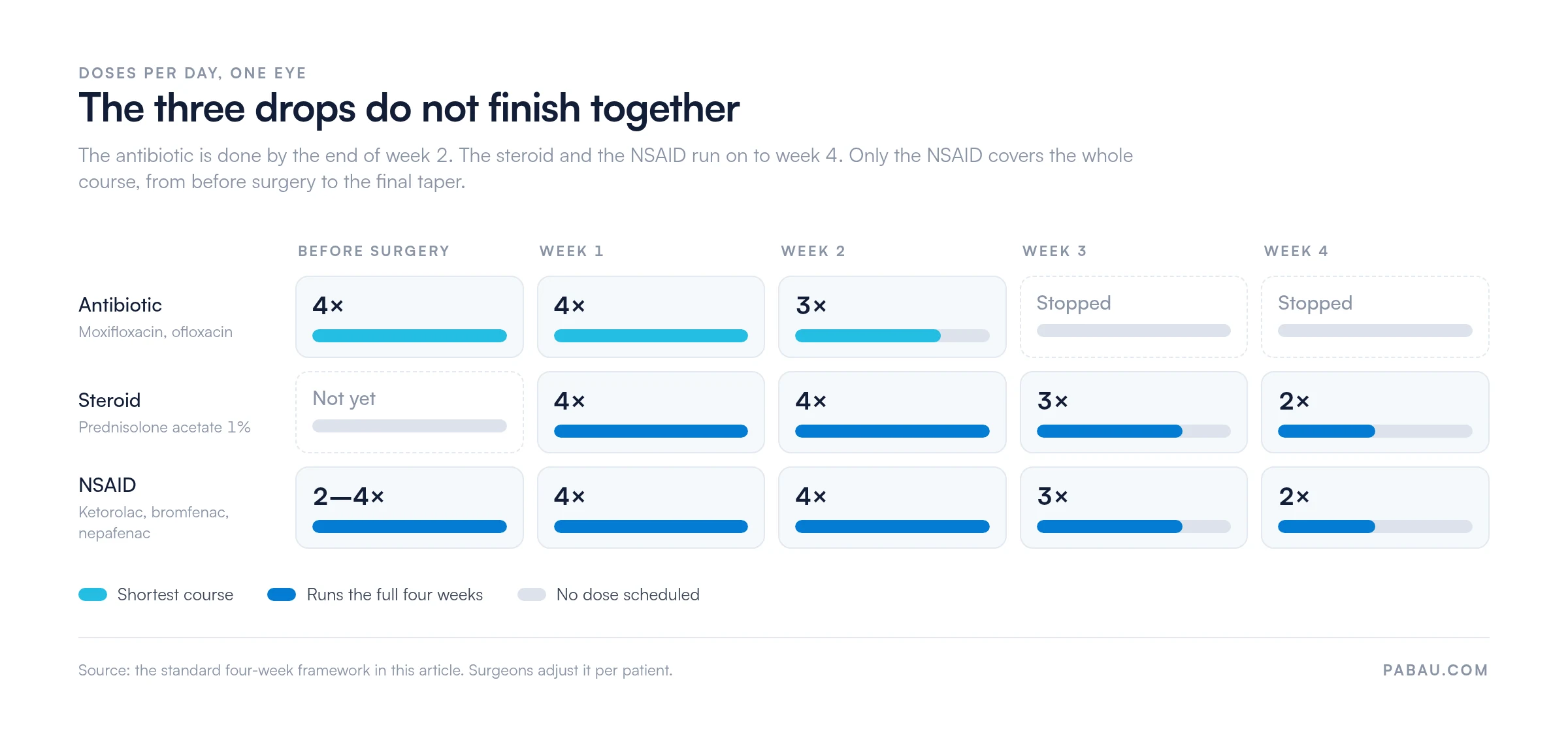
Antibiotic drops keep bacteria away from the incision while it is still fresh. Moxifloxacin, ofloxacin, and ciprofloxacin are the usual choices. A typical course runs four times daily before surgery and through week 1. It drops to three times daily in week 2, then stops at the start of week 3.
It ends there because the wound has sealed well before that point. Carrying on adds no further protection, and prolonged topical antibiotics encourage resistant organisms.
Moxifloxacin is a common first choice, since it reaches useful concentrations in the cornea and is generally well tolerated. Follow the surgeon’s own choice and frequency, which may reflect local resistance patterns or a patient allergy.
Steroid drops bring down the inflammation the surgery causes. Prednisolone acetate 1% is the standard, though some surgeons prefer dexamethasone 0.1% for its corneal penetration. The usual pattern is four times daily through weeks 1 and 2. It falls to three times daily in week 3, then twice daily in week 4 before stopping.
The step-down matters more than the starting dose. Stopping a steroid abruptly can set off a rebound inflammatory response. A gradual reduction over three to four weeks gives the eye time to settle. This is the part of the schedule patients are most likely to abandon, because by week 3 the eye feels fine.
Non-steroidal anti-inflammatory drops, usually ketorolac, bromfenac, or nepafenac, work alongside the steroid. They control discomfort and help prevent cystoid macular edema, a swelling of the central retina that can follow cataract surgery. Dosing runs two to four times daily across the four weeks, often outlasting the steroid.
NSAIDs also take the edge off the gritty ache most patients notice in the first fortnight. Used excessively they can slow corneal healing, so duration and frequency stay with the surgeon.
Some practices send patients home with an Amsler grid chart as well. A change in central vision then gets noticed between appointments, not at the next one.
Most courses begin 1 to 3 days ahead of the operation, not on the morning of it. Starting early builds drug concentration in the eye and lowers the bacterial load at the surgical site before the first incision is made. The surgeon sets the exact date and the exact bottles.
This is the point where schedules go wrong most often. The patient leaves the pre-operative visit with bottles but no written start date, so the drops sit unopened until the day before. Write the date on the chart at the visit, and the problem disappears.
After surgery the schedule steps down every week, and each bottle steps down at a different rate. Here is the standard framework, the same one the printable chart uses.
Treat this as a starting framework. Surgeons adjust the frequency and the length of the course as the eye heals. Wound healing, how quiet the eye looks at each visit, and any extra risk all feed into it. The surgeon’s written instructions always win where the two differ.
Technique decides how much of each dose the eye absorbs, so a perfect schedule still fails if the drop lands on the lower lid. Walk every post-operative patient through these five steps, ideally with a bottle in their hand.
The most common mistake is putting two or three drops in at once. Only one drop fits on the eye surface, so the rest runs down the tear duct or the cheek. The same logic drives the five-minute wait between bottles: without it, the second drop simply washes the first one out before it has been absorbed.
Five minutes at the pre-operative visit turns this download into a set of instructions a patient can follow without phoning the practice. Work through the list below before the chart leaves the building.
Put the finished chart in the post-operative pack alongside the prescriptions and the out-of-hours number. Many practices laminate it, so it survives four weeks on a bathroom shelf.
Adherence rarely fails all at once. It fails at four predictable points, and each one has a fix that takes almost no time.
One more pattern worth naming. Patients feel better by the end of week 2 and read that as recovery being over. One sentence at the post-operative visit protects the last two weeks of the course. Say that the steroid taper prevents swelling the patient cannot feel yet.
Printing and personalizing a chart for every cataract patient is a job somebody has to remember. Practice management software like Pabau moves that job off the front desk.
Pre- and post-care instructions are tied to the appointment, so the drop schedule goes out after the surgery is booked, without anyone chasing it.
The same schedule sits in the Client Portal, where patients can open it again at 11pm instead of calling the practice. Digital forms let you build a branded version that names the patient’s own bottles, their surgeon, and the date each course starts and stops.
Reminders do the rest. Email and SMS messages can land on day 3, day 7, and day 14. Each one points at the schedule and asks how the drops are going. Replies come back against the patient record, so you hear about a missed week while there is still time to act on it.

Pabau ties pre- and post-care instructions to the appointment, so every cataract patient gets their drop schedule in the Client Portal and by SMS. Your team stops printing, chasing, and re-explaining the taper.

The drops themselves are simple. What patients get wrong is the schedule, because three courses end on three different dates and only one of them is obvious. A chart that names their bottles and carries their dates removes most of that risk for the cost of a printout.
Print the template, fill in the header at the pre-operative visit, and spend a minute on what happens in week 3. Do that consistently and your post-operative calls drop, your week-4 checks get quieter, and fewer patients arrive with a macula that has quietly swollen.
If tracking who received which instructions is the part that slips, book a demo. You will see how Pabau sends, stores, and follows up on patient instruction templates like this one.

Want patients to spot macular changes between visits? The Amsler grid chart is a one-page home test that flags distortion in central vision early.
Seeing more diabetic patients on your cataract list? The diabetes eye exam template covers the screening record that sits behind their higher swelling risk.
Need a cleaner record of the pre-operative exam? The PERRLA eye exam form gives you a structured pupil and reflex assessment to file.
Wondering when a dilated exam is worth booking? The dilated eye exam walks through what the drops show the clinician and how long the effect lasts.
No fixed order applies to most regimens. What matters is the five-minute wait between different bottles, so each drop has time to absorb. If one product is a gel or an ointment, put that one in last.
Most are stored at room temperature, away from direct sunlight, but a few products differ and the label decides. Steroid suspensions such as prednisolone acetate settle in the bottle, so shake them well before every dose.
Put the drop in as soon as they remember. If the next dose is nearly due, skip the missed one and carry on as normal. Two drops are never used to catch up, and a whole missed day is worth reporting to the practice.
Only with the surgeon’s agreement. Preservative-free artificial tears are often allowed for dryness, provided five minutes separate them from the prescribed drops. Allergy drops, redness relievers, and leftover bottles from home stay out of the eye.
Yes. Vision often clears within days, well before the eye has finished healing, and inflammation can build without any symptom the patient notices. Stopping the steroid or the NSAID early risks rebound swelling that only shows up as blurring later.