CCSD code H4430: Examination of rectum under anaesthetic
CCSD code H4430 pays for the examination alone CCSD code H4430 is the UK private...

Last Updated: Oct 20, 2026
E0232 is the HCPCS Level II code for warming card for use with the non contact wound warming device and non contact wound warming wound cover.
That changes the billing question from how much E0232 pays to how you document an expected denial and who becomes liable for the charge. As a result, flagging the code as non-covered before the visit is what prevents the write-off later.
Let Pabau's smart automation suggest the right codes, reduce claim denials, and keep your practice compliant—effortlessly.
Automate repetitive tasks and focus on what matters most—your patients.
Reduce coding errors and ensure compliance with the latest regulations.
Clean claims, fewer denials, and faster reimbursements.
Powerful insights and reporting to help your practice thrive.
HIPAA compliant SOC 2 certified GDPR-compliant Trusted by 4,000+ clinics worldwide

HCPCS Code E0232 describes the warming card used with the non-contact wound warming device. In fact, it is a HCPCS Level II supply code maintained by CMS.
Medicare does not cover E0232. Specifically, National Coverage Determination 270.2 rules that non-contact normothermic wound therapy is not reasonable and necessary anywhere in the country.
CMS has published no DMEPOS fee schedule amount for E0232, so bill it with an Advance Beneficiary Notice on file and modifier GA.
E0231 covers the temperature control unit and A6000 covers the wound cover. Notably, there is no HCPCS code E0233 for this therapy.
Practice management software like Pabau keeps the signed notice, the wound record, and the supply lines on one patient file.
HCPCS Code E0232 is the official billing code for the warming card used with the non-contact wound warming device. In detail, the full CMS descriptor reads “warming card for use with the non contact wound warming device and non contact wound warming wound cover”. In practice, the code sits within HCPCS Level II, the set CMS maintains for supplies and equipment that CPT codes do not describe.
The warming card is a single-use consumable. In use, it slots into a domed wound cover that sits over the wound without touching it. Because the card is disposable rather than reusable equipment, it carries its own supply code separate from the control unit.
Non-contact normothermic wound therapy warms a wound to a set temperature without touching it. Specifically, CMS describes the device as a non-contact wound cover into which a flexible, battery-powered infrared heating card is inserted. In turn, the therapy holds the wound and surrounding skin near core body temperature, around 38°C.
Three HCPCS codes describe one therapy, and mixing them up is the most common coding error here. In other words, E0231 is the equipment, E0232 is the consumable card, and A6000 is the wound cover. Together, all three fall under the same national non-coverage rule.
Notably, there is no HCPCS code E0233 for this device family. However, some coding summaries list one as an alternate warming card, which is incorrect. In fact, the next code after E0232 in the HCPCS file is E0235, a portable paraffin bath unit.
Reviewers expect all three codes to tell one consistent story. For instance, a card billed with no device or cover on record contradicts itself. A denial is still a claim, so the line has to be built as carefully as a payable one.
Medicare does not cover HCPCS Code E0232. National Coverage Determination 270.2, Noncontact Normothermic Wound Therapy, has been in force since July 1, 2002. It finds insufficient scientific or clinical evidence to consider the device reasonable and necessary for treating wounds. Therefore, the therapy will not be covered by Medicare.
The determination rests on section 1862(a)(1)(A) of the Social Security Act. Specifically, it appears in the Medicare National Coverage Determinations Manual, Publication 100-03, Chapter 1, Part 4, carried forward from CIM 60-25.
Because 270.2 is national, no Medicare Administrative Contractor can open coverage locally. Furthermore, the CMS Program Integrity Manual, Chapter 13, bars a MAC from issuing a Local Coverage Determination that conflicts with an existing NCD. As a result, there is no LCD, no medical-necessity pathway, and no prior authorization route for E0232.
The plan’s own rules decide which notice you have to issue. In practice, documented consent and a clear price quote are what keep the charge defensible. Overall, compliance rules apply just as firmly to a non-covered item as to a payable one.
Medicare has not established a fee schedule amount for HCPCS Code E0232. The code has no row on the CMS DMEPOS fee schedule in any locality, and neither do E0231 or A6000. Indeed, that means there is no allowed amount, no locality adjustment, and no limiting charge to calculate.
The right file to check is the quarterly DMEPOS fee schedule, not the Physician Fee Schedule lookup tool. E0232 is a durable medical equipment (DME) item, so the Physician Fee Schedule would never carry it. Download the current DMEPOS file, filter for E0232, and the search returns nothing.
Here is how the usual reimbursement checks land on this code:
Practices that still offer this therapy price it as a self-pay item. The warming card then sits in the books as a retail supply cost rather than a reimbursable line. When you submit the claim to put the denial on record, the remittance confirms the reason code that moves the balance.
Before quoting a price for non-contact wound warming, download the current quarterly DMEPOS fee schedule and search for E0231, E0232, and A6000. Then, save the empty result alongside your ABN template. It answers the audit question about why the item was billed to the patient rather than to Medicare.
Billing E0232 correctly means building a claim that will be denied, and denied for the right reason. In particular, three elements decide that outcome. Namely, they are the modifier, the diagnosis code, and the notice you gave the patient beforehand. Additionally, reviewing the common denial codes helps billers read the remittance and route the balance to the right place.
Modifier GA or GZ applies to E0232, depending on whether you obtained an Advance Beneficiary Notice. However, Modifier KX does not apply at all. To clarify, KX attests that the criteria in a local coverage policy have been met, and no such policy exists for this code.
The choice between them is settled before treatment, not at billing.
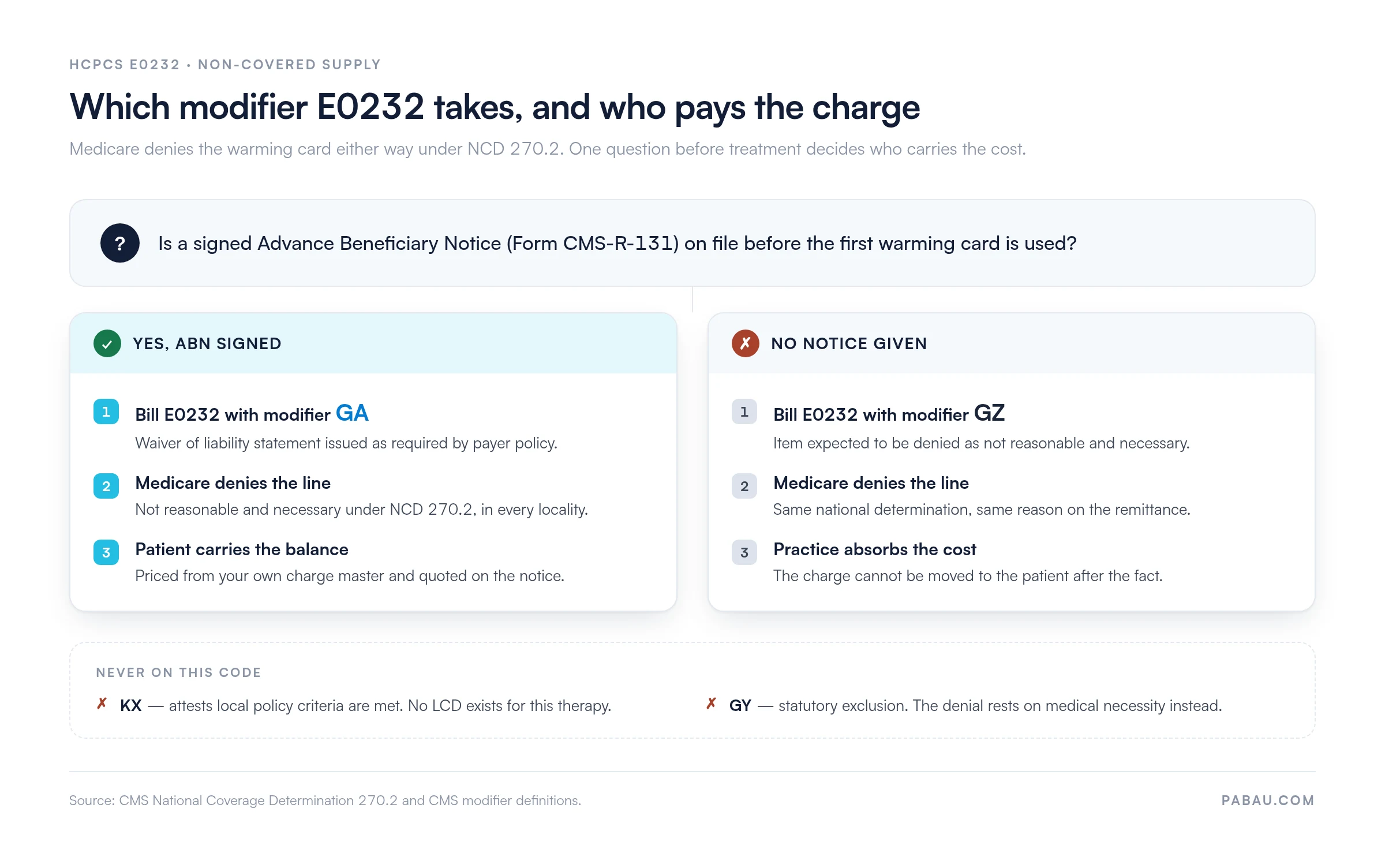
The wrong modifier here creates avoidable rework and can strand a balance the practice is entitled to collect. In short, chasing denials caused by a habitual KX costs more staff time than issuing the notice would have.
A wound-related ICD-10 code still belongs on the claim, even though the line will deny. In turn, the diagnosis supports the clinical record, any commercial appeal, and the patient’s own submission to a secondary plan. In summary, the table below shows the categories documented most often in wound care settings.
Documentation for a non-covered item protects the practice rather than the claim. The record has to show that the patient understood the cost and agreed to it before treatment started. Each item below belongs in the chart before the first warming card is opened.
Most E0232 problems come from treating the code like a payable DME supply. In fact, the table below covers the six that show up most often in wound care billing reviews.
Commercial payers reach the same conclusion as Medicare, usually through their own technology assessments. For example, UnitedHealthcare’s medical policy on warming therapy calls non-contact normothermic wound therapy unproven and not medically necessary for treating wounds, citing insufficient evidence of efficacy.
Medicare Advantage plans apply national coverage rules, so E0232 is non-covered there too. Similarly, several Blue Cross plans and Centene’s clinical policy take comparable positions. Check the specific plan’s medical policy before treatment, and issue the plan’s own notice of non-coverage where one is required.
E0232 sits in the heat, cold, and light therapies range, E0200 through E0239. One neighbor carries a very similar coverage story, which is worth knowing before you bill it.
Charge capture is the practical risk across this whole range. In practice, a visit-level supply list keeps the non-covered lines visible to whoever posts the patient balance.
Flag E0231, E0232, and A6000 as ABN-required items in your charge master. Then, the prompt fires when the appointment is booked, rather than at checkout after the treatment has already happened.
Code lookup tools tell you what E0232 means. However, they do not hold the signed notice, the wound assessment, and the per-session supply log that a non-covered item needs. Practice management software like Pabau keeps those records against the patient, so the paperwork exists before the balance does.
Pabau’s medical claims management keeps the billing workflow in one place, from the patient record through to claim submission and payer response. As a result, wound documentation, the signed ABN, and the supply lines all stay attached to the same appointment.
For wound care practices, that means the notice is on file before the first warming card is used. Every session’s supply line is then visible at checkout. Meanwhile, payer responses arrive as electronic remittance advice in the same system that holds the appointments and clinical notes. When the denial for E0232 lands, posting the patient balance takes minutes.

Pabau helps wound care practices document treatment, keep patient notices on file, and submit claims from one platform. See how it works for your practice.

In short, HCPCS Code E0232 has a clean descriptor and no Medicare payment behind it. NCD 270.2 has ruled non-contact normothermic wound therapy out of coverage since 2002, and CMS publishes no fee schedule amount for the card. The billing work here is about consent, pricing, and the paper trail rather than reimbursement.
Practices that handle it well issue the notice first, quote a specific figure, and keep the wound record attached to the charge. In turn, Pabau’s documentation and claims tools hold those pieces together for every session. To see how it works for your practice, book a demo with the team.

Need guidance on avoiding claim rejections? Denial codes in medical billing explains the most common rejection codes and how to address them before resubmission.
Want to understand the full claims lifecycle? How a medical claims clearinghouse works covers how DME supply claims move from your system to the payer.
Looking to tighten up your revenue cycle? Best medical billing software in the US reviews the leading platforms for outpatient and DME billing workflows.
HCPCS Code E0232 is a HCPCS Level II supply code for the warming card used with the non-contact wound warming device. Specifically, it is a durable medical equipment supply item, billed once for each replacement card used in a treatment session.
No. In fact, Medicare does not cover E0232 anywhere in the country. National Coverage Determination 270.2 finds insufficient evidence that non-contact normothermic wound therapy is reasonable and necessary for treating wounds. Because the rule is national, no MAC can issue a local policy that covers it.
There is none. Indeed, CMS has not established a fee schedule amount for E0232, and the code has no row on the DMEPOS fee schedule in any locality. E0231 and A6000 have no published amount either, so the price is set by your own charge master.
Modifier GA applies when a signed Advance Beneficiary Notice is on file before treatment, which shifts liability to the patient. In contrast, Modifier GZ applies when no notice was obtained, and the charge cannot then be billed to the patient. However, Modifier KX does not apply, because there is no local coverage policy for this code to attest against.
Wound diagnoses used with E0232 include the L89.xxx pressure ulcer range, L97.xxx for lower limb chronic ulcers, and E11.621 for diabetic foot ulcer. Select the code that reflects the documented wound type and site, even though the line will deny.