

CCSD code G5100: Bypass of duodenum billing guide
CCSD code G5100 bills a bypass that leaves the duodenum in place CCSD code G5100...

Last Updated: Oct 16, 2026
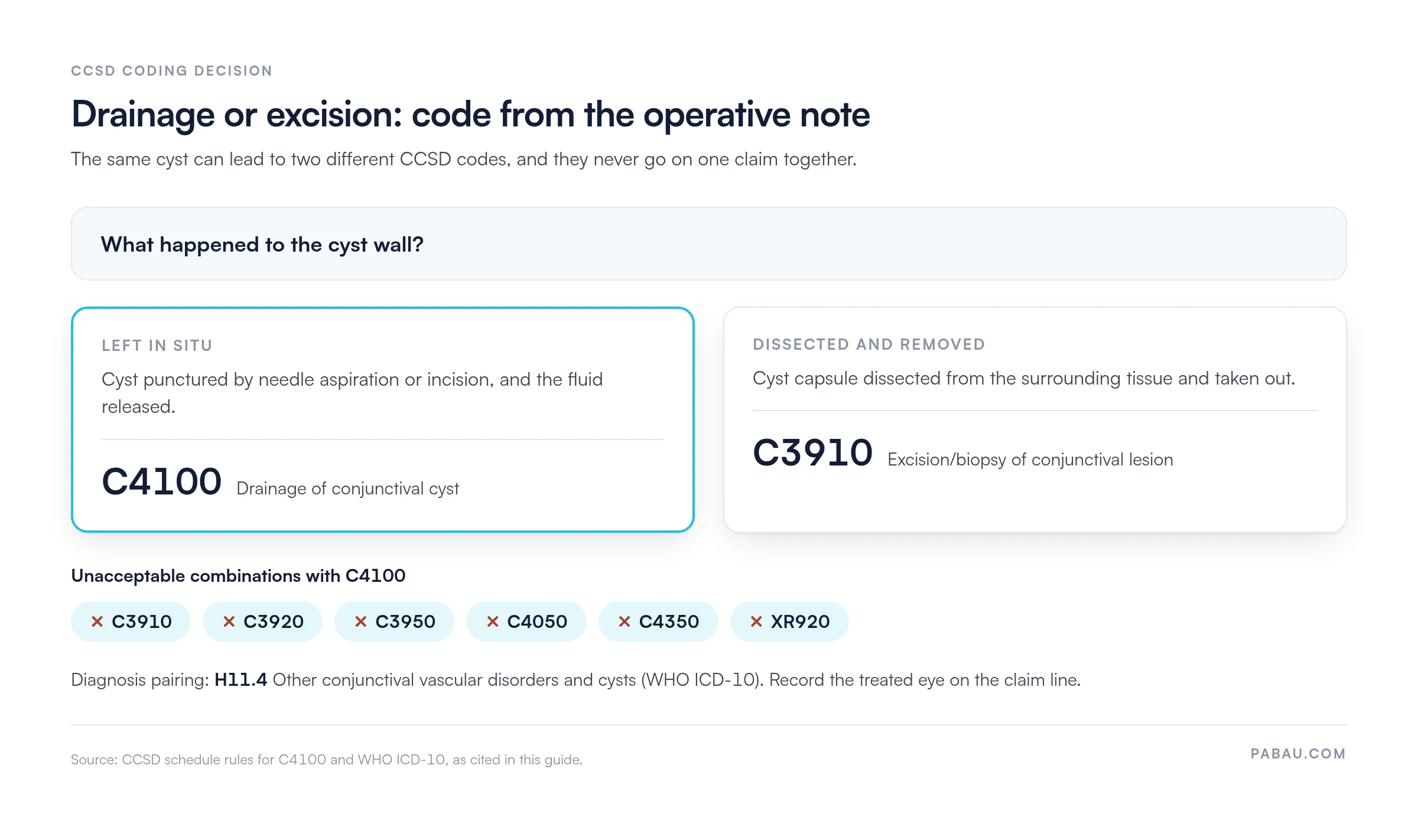
C4100 is the CCSD code for drainage of a conjunctival cyst, billed to UK private insurers. It applies when the cyst is punctured or incised and its fluid released, with the cyst wall left in place.
Complete removal of the cyst wall is coded as C3910 (excision/biopsy of conjunctival lesion), and the two cannot be billed together. Pair C4100 with WHO ICD-10 code H11.4.
Let Pabau's smart automation suggest the right codes, reduce claim denials, and keep your practice compliant—effortlessly.
Automate repetitive tasks and focus on what matters most—your patients.
Reduce coding errors and ensure compliance with the latest regulations.
Clean claims, fewer denials, and faster reimbursements.
Powerful insights and reporting to help your practice thrive.
HIPAA compliant SOC 2 certified GDPR-compliant Trusted by 4,000+ clinics worldwide

CCSD Code C4100 covers drainage of a conjunctival cyst, with the cyst wall left in place, while complete excision is coded as C3910.
Pair C4100 with WHO ICD-10 code H11.4 and record the treated eye on the claim line, because UK ICD-10 has no laterality character.
C4100 cannot be billed alongside C3910, C3920, C3950, C4050, C4350 or XR920.
Pre-authorisation rules differ by insurer, procedure and policy, so check each insurer’s current position before the procedure.
Pabau, the practice management platform we build, keeps the operative note and pre-auth reference on one record and submits the claim through Healthcode.
CCSD Code C4100 is the procedure code for drainage of a conjunctival cyst in the Clinical Coding and Schedule Development schedule for UK private healthcare. It applies when an ophthalmologist drains a fluid-filled cyst from the conjunctival tissue, as distinct from excision (surgical removal) and from other conjunctival procedures.
The schedule is maintained by the CCSD Group, which represents UK private medical insurers and hospital providers. Every major UK private insurer uses its codes to process and adjudicate specialist invoices.
C4100 sits in chapter 4 of the schedule, which covers the eye and orbital contents, alongside the other CCSD codes for the conjunctiva. Private ophthalmology practices in England, Scotland and Wales use these codes whenever they invoice insurers directly. Billing administrators working in Healthcode reference them at the point of claim submission. The code applies only to drainage: if the cyst was excised completely, C3910 applies instead.
Drainage of a conjunctival cyst is a minor ophthalmological procedure that decompresses a fluid-filled sac arising from the conjunctiva. The conjunctiva is the thin transparent membrane that covers the white of the eye and lines the inner eyelids. The procedure is typically carried out under topical anaesthesia, using drops such as proxymetacaine or tetracaine to numb the ocular surface without injection or sedation.
The procedural sequence generally follows these steps:
Because this is a minor procedure under topical anaesthesia, it is typically performed in an outpatient room rather than a theatre. That setting matters for billing, because theatre facility fees are not routinely applicable. Claiming a separate general or local anaesthesia code alongside C4100 when only topical drops were used would be incorrect and may trigger an audit.
C4100 is appropriate when a symptomatic retention cyst or epithelial inclusion cyst has grown large enough to need draining. Small, asymptomatic lesions are usually watched rather than treated. Clinical indications that support billing C4100 include:
Record the specific symptom burden and clinical finding that justified drainage. UK private insurers assess medical necessity at adjudication, and they scrutinise procedures that look cosmetic in isolation more closely. An operative note that records presenting symptoms, duration, cyst size and the ophthalmologist’s reasoning for draining will support the claim.
Pair C4100 with H11.4 (other conjunctival vascular disorders and cysts), the WHO ICD-10 category that UK private insurers use for a conjunctival cyst. UK ICD-10 has no laterality character, so record the treated eye on the claim line and in the operative note instead. Insurers cross-reference the procedure code against the diagnosis code to confirm medical necessity, so a mismatch between the two is a common denial trigger.
NHS and UK private insurers use the NHS Classifications Browser as the reference for ICD-10 coding in the UK. Confirm that H11.4 is current and correctly mapped in your billing system before submission. Mismatched or unspecified ICD-10 codes are a common reason for denial.
The most consequential miscoding risk with CCSD Code C4100 is confusing drainage with excision. These are distinct procedures with different CCSD codes, and conflating them on a claim is miscoding regardless of intent. The distinction turns on the operative note. Did the surgeon incise, aspirate and decompress the cyst (drainage), or excise the cyst wall and remove it completely (excision)?
Complete excision of the cyst is coded as C3910. Because C3910 is a lesion code, CCSD rules do not allow it on the same claim as C4100. The schedule also lists C3920, C3950, C4050, C4350 and XR920 as unacceptable combinations with C4100.
Check the live schedule at ccsd.org.uk before completing a claim, as the annual revision can change codes in adjacent categories. The clinical distinction is clear-cut when documented accurately. A drainage note records aspiration or incision with fluid release, while an excision note records dissection of the cyst capsule from surrounding tissue. The decision below shows which code each note supports.
Bilateral conjunctival cyst drainage on the same date of service is uncommon but does occur. The claim structure then depends on the specific insurer’s billing rules, so confirm requirements before submission.
Flag bilateral C4100 claims for manual review before submission. Write the laterality in the procedure description field on each claim line, such as ‘right eye’ and ‘left eye’. Attach the operative note for both eyes. Insurers that auto-process single-eye claims often hold bilateral submissions for manual adjudication, so proactive documentation cuts turnaround time.
Pre-authorisation (pre-auth) requirements for CCSD Code C4100 vary by insurer, by procedure and by the patient’s policy. Requirements change with annual policy updates, so check the insurer’s current provider portal or clinical policy document before the procedure. The table below lists where to check each insurer’s current position.
A pre-auth request typically asks for the clinical indication, the proposed procedure and the expected date of service. Insurers also ask for the referring GP or consultant. Record the authorisation reference number before the appointment so it reaches the claim. A missing pre-auth reference on a submitted claim is a routine denial trigger.
Also review the Bupa CCSD code schedule for Bupa-specific procedure code guidance and any code-level notes that affect C4100 claims under Bupa policies.
A complete operative note is the most important document supporting a C4100 claim. Insurers review operative notes when adjudicating borderline claims or during post-payment audits, and an incomplete note is grounds for recovering funds already paid.
Every C4100 operative note should contain:
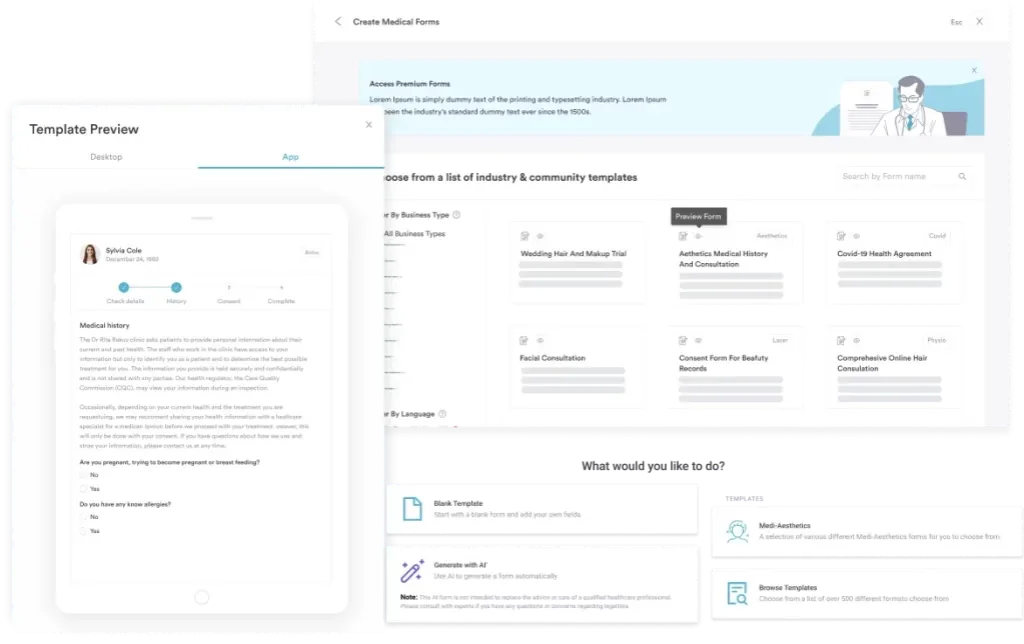
A digital operative note template built around these fields reduces the risk of omission. Pre-populated fields for laterality, anaesthetic type and procedure descriptor give coders and billers the details they need at the point of claim generation. A patient record that captures the full clinical encounter also makes post-payment audit responses faster and more complete.
C4100 claims are denied for a predictable set of reasons. Knowing them in advance lets billing administrators build prevention steps into the submission workflow instead of correcting claims afterwards.
A pre-submission checklist built into your claims management software catches most of these before a claim leaves the practice. A denial costs resubmission time and delays payment, which usually outweighs the few minutes spent checking the claim first.
In many ophthalmology practices, the operative note lives in one system and the pre-auth reference sits in an email. The claim is then keyed into Healthcode by hand. Each handover is a chance to drop the laterality, the anaesthetic type or the authorisation number.
Pabau holds these pieces on one patient record. The C4100 operative note is completed on a digital form with fields for laterality, technique and anaesthetic. The pre-auth reference is stored in the record or on the intake form. The claim then goes to the insurer through Pabau’s claims management, which submits via Healthcode.
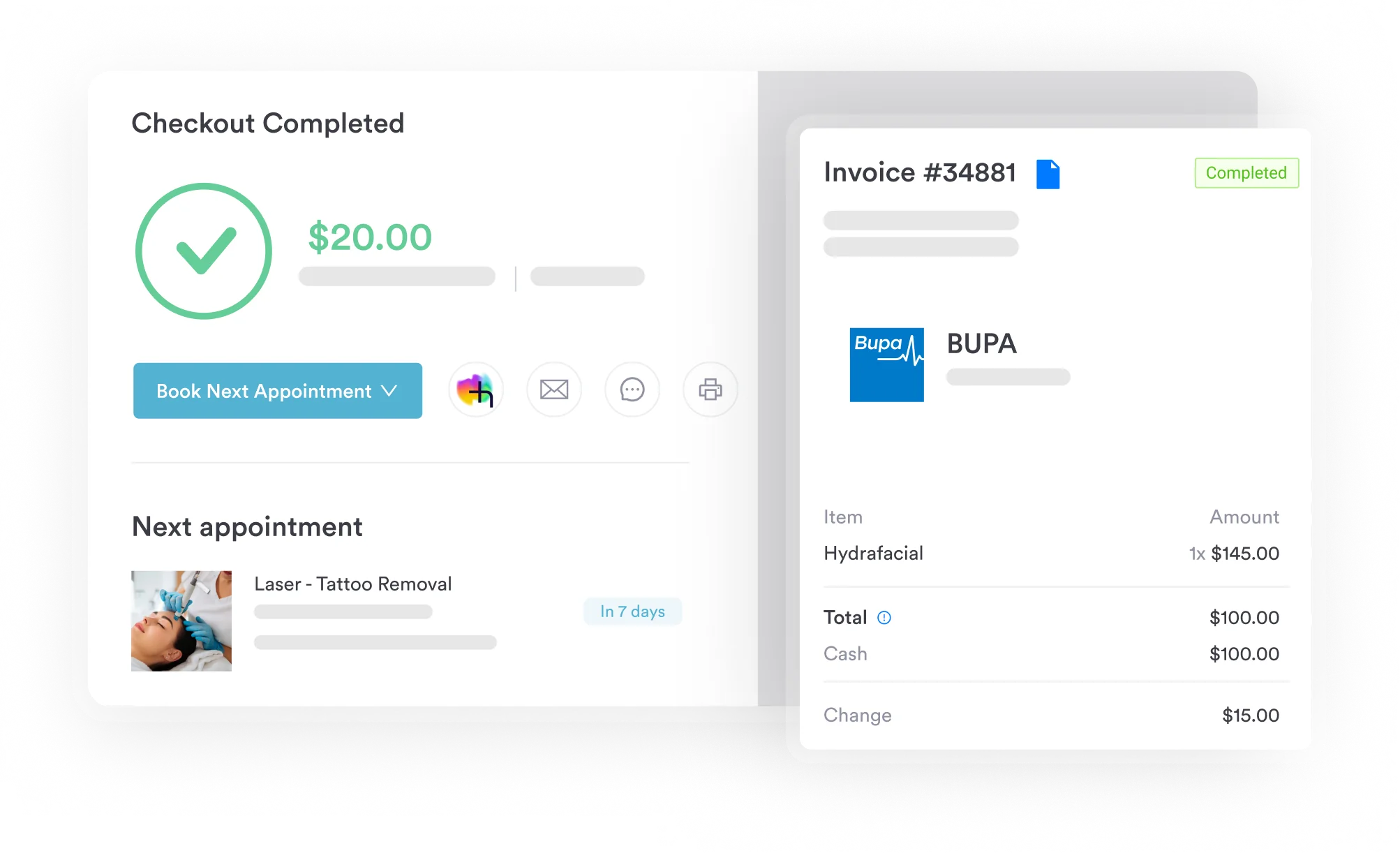
The billing team works from the note the ophthalmologist signed, not from a retyped summary. That makes a drainage-versus-excision mix-up or a missing reference easier to catch before submission.

Pabau keeps the operative note, the pre-auth reference and the Healthcode claim on one patient record, so fewer CCSD claims come back for correction.

Code C4100 from the operative note, never from the booking. If the note records fluid released and the wall left in place, bill C4100 with H11.4 and the treated eye on the claim line. If the capsule came out, the claim is C3910, and the two never appear together.
Most C4100 denials trace back to a note missing laterality or anaesthetic type, or a pre-auth reference that never reached the claim. Fix those at the template stage and the claim rarely needs a second pass.
Pabau, the practice management platform we build, keeps the operative note, the pre-auth reference and the Healthcode claim on one record. Book a demo to see how your team can send cleaner CCSD claims with fewer resubmissions.

Billing a Bupa patient? Bupa CCSD codes explains how Bupa structures its procedure code guidance for UK private practices.
Removed the cyst wall instead? CCSD code C3910 covers excision or biopsy of a conjunctival lesion and how to document it.
Cauterised the lesion? CCSD code C3920 walks through billing conjunctival lesion cauterisation, one of the codes that cannot be combined with C4100.
Treating a conjunctival lesion with radiotherapy? CCSD code C3950 sets out the coding and documentation for radiotherapy to a conjunctival lesion.
CCSD Code C4100 covers drainage of a conjunctival cyst, a minor ophthalmological procedure. The fluid-filled cyst is punctured and its contents aspirated or expressed. It applies only to drainage, not to excision of the cyst wall.
Pair C4100 with H11.4 (other conjunctival vascular disorders and cysts), the WHO ICD-10 category UK insurers use for a conjunctival cyst. UK ICD-10 has no laterality character, so record the treated eye on the claim line and in the operative note. An unspecified or unrelated diagnosis code is a common reason the claim is denied.
Pre-authorisation requirements vary by insurer, procedure and policy type, and they change with annual updates. Check the current policy of Bupa, AXA Health, Vitality or Aviva before the procedure takes place. Submitting a claim without a required pre-auth reference is a routine denial trigger.
The main denial reasons are a wrong procedure code, such as excision billed instead of drainage, and a missing pre-authorisation reference. Others are an incorrect or non-specific ICD-10 pairing, undocumented laterality, and a separate anaesthesia code when only topical drops were used. All five are preventable with a structured pre-submission checklist.



