Health appraisal form
A health appraisal form is a record a licensed provider signs to document someon...

2
Last Updated: Oct 13, 2026

Software covered: 1. Pabau, 2. Vagaro, 3. Mindbody, 4. Glofox, 5. Pike13
WellnessLiving suits fitness studios, but it holds no clinical documentation and draws repeated complaints about support response times
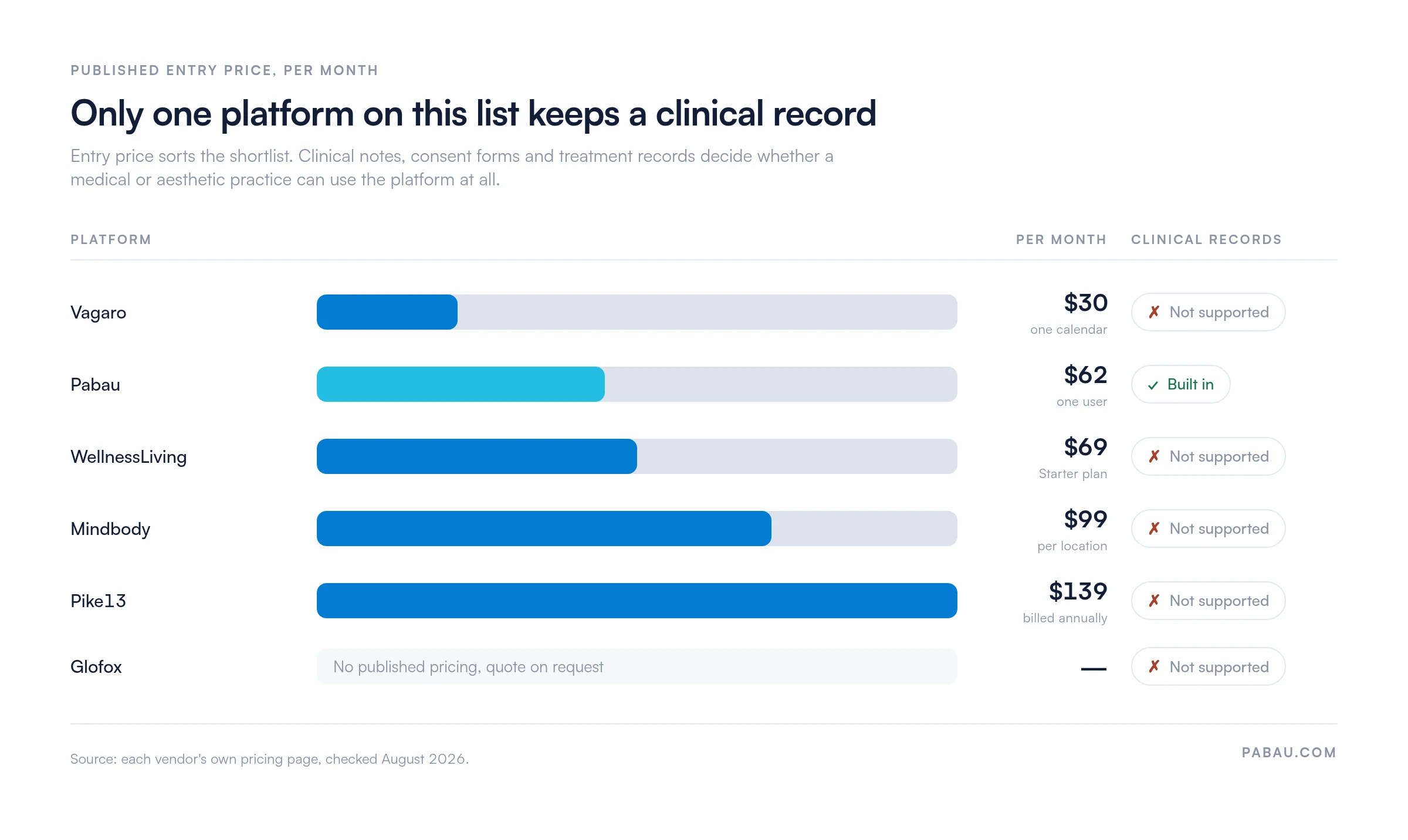
Pabau is the only platform here with clinical notes, consent forms, and treatment records built for medical and aesthetic practices
WellnessLiving publishes plans from $69 to $349 a month, and users report paid extras for marketing, reporting, and priority support
Vagaro has the lowest entry price at $30 a month, and Pike13 the highest at $139 billed annually
Most WellnessLiving users start shopping for an alternative because the invoice keeps growing, not because the platform stops working. Users report paid extras for email marketing, reporting, and priority support on top of the published plan price. Support response times sit near the top of the complaint lists on Capterra and G2.
Here is the short answer. Pabau is the strongest replacement for medical spas and aesthetic practices, Vagaro for salons and small studios, and Glofox for gyms. We compared five platforms on published pricing, scheduling depth, clinical capability, and support quality.
Whether you run a gym, a yoga studio, a day spa, or an aesthetics practice, one of these fits your workflow better than WellnessLiving. It will usually cost less than the price you currently pay, too.
Here is how the five platforms compare across the criteria that matter most to studios, spas, and clinical practices.
The chart below sets each platform’s published entry price against whether it can hold a clinical record.
WellnessLiving works well for fitness studios and yoga businesses that need class scheduling and a consumer-facing booking app. The platform’s problems tend to surface once a business scales or starts layering in more operational requirements.
The most consistent complaints across Capterra and G2 fall into four areas:
None of these are dealbreakers for a simple yoga studio. They become dealbreakers fast for a growing spa, a multi-location wellness group, or any practice that needs clinical documentation.
The only platform here that keeps the booking, the consent form, and the treatment note in one client record.
Pabau is an all-in-one practice management platform built for medical spas, aesthetic practices, dermatology groups, and multi-disciplinary wellness clinics. WellnessLiving serves fitness and wellness businesses that need class management and booking.
Pabau serves the clinical side of wellness: practices handling regulated treatments, patient records, consent documentation, and prescribing workflows. It is the only platform on this list with those capabilities built natively rather than bolted on through integrations.
Pabau supports medical spa software workflows across scheduling, clinical documentation, payments, marketing, and reporting. Every core feature sits in the base subscription, so no tier locks you out of reporting or marketing. Marketing Plus and Care Plus are optional paid add-ons for practices that want to do more in one specific area.
The platform scales from a single-location aesthetic practice to a multi-site clinical group without a change in pricing model.
According to Capterra reviewers, Pabau earns 4.7 out of 5 from over 600 verified reviews. Positive themes include ease of clinical documentation and the quality of onboarding support.
Reviewers also report less tool sprawl once scheduling, clinical records, and marketing sit in one platform. Occasional sync issues and mobile app improvements are the most cited areas for development.
| Plan / Tier | Price | Details |
|---|---|---|
| Starter | From $65/month | Per practitioner; billed monthly |
| Team / Group | Scales by location and user count | Volume-based pricing |
| Enterprise | Custom pricing | Contact sales for a quote |
Pabau starts at $104 a month for one user and scales with locations and team size. The full breakdown sits on Pabau’s pricing page.
The clearest pricing in the category, as long as you never need to keep a clinical record.
Vagaro is a popular choice for salons, spas, and small fitness studios that want capable scheduling without the pricing complexity of WellnessLiving or Mindbody.
Pricing runs per location and per calendar. It starts at $30 a month for the first calendar and rises by $10 for each additional one. The cap sits around $90 a month for seven or more calendars.
That structure is one of the clearest in the category. For a solo practitioner or a small spa with a handful of staff, the monthly cost is easy to predict. It also lands well below WellnessLiving’s total cost of ownership once paid extras are counted. Vagaro runs a consumer-facing marketplace too, which surfaces your business to new clients.
Vagaro ranks above Mindbody here for two reasons. It holds a higher Capterra rating, and its pricing is published in full rather than quoted per location with modules on top.
Vagaro holds a 4.7/5 on Capterra, one of the highest ratings among WellnessLiving alternatives. Reviewers praise the platform’s ease of use and the value for money at its entry price point. Negative reviews focus on reporting limits and occasional support inconsistency.
| Plan / Tier | Price | Details |
|---|---|---|
| Just Me (single calendar) | $23.99/month (promo; regular ~$30) | 1 bookable calendar; full feature set |
| Additional bookable calendars | +$10/month per calendar | Scales with team size; capped at 7 calendars |
Vagaro charges $30 a month for the first calendar and $10 for each extra one, so a seven-calendar spa pays around $90 a month.
Buys marketplace reach at a price small studios struggle to justify.
Mindbody is the largest platform in the wellness software space by brand recognition. It runs a consumer-facing marketplace listing thousands of studios and wellness businesses, which gives larger chains a new-client acquisition channel.
The platform covers class scheduling, membership management, marketing automation, and point-of-sale processing for multi-location wellness businesses at scale.
The trade-off is cost and complexity. Mindbody’s pricing starts around $99 a month per location, and paid modules for further features raise the effective monthly cost considerably.
For a business that found WellnessLiving’s paid extras frustrating, Mindbody is unlikely to solve that problem.
For larger chains where marketplace visibility matters and the budget allows, it remains the dominant choice in its category. Our side-by-side platform comparisons break down how Pabau differs from Mindbody feature by feature.
Mindbody holds a 4.0/5 on Capterra. Positive reviews consistently mention the marketplace and the breadth of features for larger operations. Negative reviews focus on high pricing, expensive modules, and customer support that reviewers describe as slow to resolve issues.
| Plan / Tier | Price | Details |
|---|---|---|
| Starter / Accelerate / Ultimate | Not publicly accessible | Tiers named but no prices; Let’s talk / demo |
Mindbody publishes a starting price of $99 a month per location, and the paid modules a full deployment needs raise the total from there.
A branded member app no other platform here matches, sold without a published price.
Glofox is built specifically for gyms and fitness studios. Its core value proposition is a branded mobile app that members download to book classes, manage memberships, and interact with your business.
For a gym or CrossFit box, a client-facing app can be central to the member experience. Glofox delivers one natively, which neither WellnessLiving nor most of its alternatives do.
Pricing is not published and requires a sales conversation, which makes budget comparison harder. Glofox is generally positioned as a mid-to-premium product for fitness businesses. Small gyms with limited budgets may find the cost difficult to justify.
Glofox holds a 4.4/5 on Capterra. Reviewers consistently highlight the branded app and membership management as strengths. The most common negatives are limited integrations and reporting that does not match the depth of larger platforms.
| Plan | Price | Who it’s for | Key inclusions |
|---|---|---|---|
| All plans | No published pricing | Gyms and fitness studios | Branded app, membership management, class scheduling, retention reporting |
Glofox publishes no prices on its own site, so a budget comparison has to wait until their sales team quotes your gym.
A clean scheduling tool for appointment-led businesses that do not need marketing depth.
Pike13 takes a different approach to the wellness software category. Rather than building a consumer marketplace or a feature-laden platform, it focuses on clean staff scheduling, client management, and reporting for service-based businesses.
That covers personal trainers, yoga instructors, coaching businesses, and wellness practitioners who work in appointment-led rather than class-led formats.
The interface is consistently praised as intuitive and uncluttered, which matters for small teams without a dedicated administrator. The trade-off is fewer integrations and limited marketing automation compared with WellnessLiving and most of its alternatives.
Pike13 holds a 4.1/5 on Capterra. Reviewers highlight the clean interface, reliable scheduling, and good staff management tools. The most consistent negatives are limited marketing features and fewer integrations than comparable platforms.
| Plan | Price | Who it’s for | Key inclusions |
|---|---|---|---|
| Core | $139/month billed annually, or $159 billed monthly | Small service-based wellness businesses | Scheduling, client management, reporting |
| Pro | Contact sales | Growing businesses with multi-staff needs | Core features plus deeper reporting and more integrations |
Pike13 publishes the Core plan at $139 a month on an annual commitment, rising to $159 if you pay monthly. Pro pricing comes from a sales conversation.
Cost is consistently one of the top reasons businesses look for WellnessLiving alternatives. The table below compares headline pricing and what each base plan typically includes.
Note on WellnessLiving pricing: WellnessLiving publishes four plans on its own site. Starter runs $69 a month, Business $199, BusinessPro $349, and Enterprise is quoted on request. The paid extras users describe for marketing, reporting, and priority support sit on top of those figures. Confirm current costs with each vendor before you commit.
No single platform wins across every business type. Here is the clearest recommendation by vertical, based on the feature analysis above.
The right platform depends less on feature checklists than on what your business does day to day. Five questions worth answering before you commit:
Businesses torn between the two marketplace platforms can read our Mindbody vs Vagaro comparison before they shortlist.
Before you commit to any platform, ask for a full cost breakdown. Make it include the extras your business needs: email marketing, deeper reporting, priority support, and additional locations. The base plan price is rarely the final monthly cost for a growing wellness business.
A studio changing platforms only has to move classes, memberships, and payments. A practice offering injectables, IV therapy, or skin treatments also has to move consent forms, treatment notes, and before-and-after photos. On a fitness platform those records end up in a shared drive, a paper file, or a second system nobody reconciles.
Pabau keeps them in one client record. The consent form goes out before the appointment and comes back signed. The treatment note attaches to the visit it belongs to. Photos sit beside both, so the next practitioner sees the treatment history without asking a colleague.
That gives you one platform for the booking, the payment, and the record. Every core feature sits in the base subscription, so a growing practice never renegotiates its plan to unlock reporting or marketing. Marketing Plus and Care Plus are optional add-ons for practices that want to do more in one specific area.

Pabau brings scheduling, clinical notes, consent forms, and integrated payments into one platform, with every core feature in the base subscription. Book a personalized demo to see it running for your practice type.

The decision comes down to one question. Does your business keep a clinical record? If it does, the shortlist is short, because five of the six platforms here cannot hold one. If it does not, price and ease of use decide it, and Vagaro wins on both.
Either way, price the platform you will be running in a year rather than the one you are buying today. Add the extra locations, the extra calendars, and the modules you know you will want. That total is what made WellnessLiving feel expensive, and it is the number worth comparing.
For medical spas, aesthetic practices, and wellness businesses handling regulated treatments, Pabau covers clinical documentation, consent forms, and treatment records alongside scheduling and payments. Book a demo to see how that works for your treatment list and your team.

Weighing Mindbody rather than WellnessLiving? Mindbody alternatives worth considering covers the platforms wellness businesses shortlist when Mindbody gets too expensive.
Shortlisted Vagaro and want to know its limits? Vagaro alternatives for growing practices explains where the per-calendar model starts to strain.
Need Mindbody’s numbers before a sales call? Mindbody pricing explained breaks down the plan tiers and the modules that raise the monthly total.
Running a salon or beauty business? GlossGenius alternatives compared reviews the booking platforms built for salons and independent stylists.
The best WellnessLiving alternatives are Pabau for medical spas and aesthetic practices, Vagaro for salons and small spas, and Mindbody for large wellness chains. Glofox suits gyms and fitness studios, and Pike13 suits service-based practitioners. The right choice depends on your business type, clinical requirements, and budget. Pabau is the only alternative with native clinical documentation for regulated practices.
WellnessLiving works well for fitness-focused businesses like yoga studios and gyms, but it is not designed for clinical or medical spa management. It holds no clinical notes, consent form management, or treatment records, which are essential for any practice operating under clinical or aesthetic regulations. Pabau is a more appropriate option for those workflows.
Yes. Pabau is built for the clinical and aesthetic side of wellness. It includes native clinical notes, digital consent forms, treatment records, before-and-after photo management, and integrated payments, all in the base subscription. Marketing Plus and Care Plus are optional paid add-ons for practices that want to do more in one area. Pabau covers medical spas, aesthetic practices, dermatology groups, IV therapy clinics, and multi-disciplinary wellness centers.
The most common reasons are paid extras that raise the monthly invoice above the advertised plan price. Slow support response times come next. Practices with medical or aesthetic requirements also leave because there is no clinical documentation, and some cite integration limits with CRM and marketing tools. These complaints appear consistently across Capterra and G2 review platforms.
Vagaro starts at $30 a month for a single calendar, making it the lowest entry-price WellnessLiving alternative reviewed here. Pabau starts from $104 a month and Mindbody from $99 a month per location. Pike13 is the most expensive at $139 a month billed annually. Always request a full cost breakdown including any extras before committing, because headline prices differ from effective monthly costs.
WellnessLiving publishes four plans on its own site, from $69 a month for Starter to $349 for BusinessPro. Users consistently report on Capterra and G2 that features including email marketing, deeper reporting, and priority support carry costs on top of those plans. Reviewers describe those charges as raising the monthly total significantly, so confirm what your shortlist of features costs before switching.