



The Schmidt sting pain scale rates how much an ant, bee, or wasp sting hurts, from 0 to 4. Entomologist Justin O. Schmidt built it, and a sweat bee sits at 1.0 while a bullet ant sits at 4.0.
Schmidt designed the ratings to compare species in ecological and evolutionary research. They carry no validation as a measure of a patient’s pain, and they say nothing about allergy risk.
What the index does give you is a reference for how much a sting should hurt, which helps when a patient asks. Below, each level gets its species, Schmidt’s own wording, and what a practice usually sees.
Download your free insect sting reaction record template
A one-page form for logging an insect sting presentation. It covers the insect involved, where and when the sting happened, the size of the local reaction, and the systemic signs you checked. There is space for the treatment given and the review date you agreed with the patient.
Download template
Key takeaways
Justin O. Schmidt’s sting pain index rates Hymenoptera stings from 0 to 4 to compare species with each other.
His 1990 paper classified 78 species across 41 genera, and his 2016 book The Sting of the Wild set out the descriptions in full.
Schmidt built the index for ecological and evolutionary research, so it carries no validation as a patient pain measure.
Patient pain is scored with the numeric rating scale, the visual analog scale, Wong-Baker FACES, or the McGill Pain Questionnaire.
How much a sting hurts says nothing about allergy risk, so sting triage runs on systemic signs instead.
What the Schmidt sting pain scale measures
It measures sting pain, and only sting pain. The scale, more properly called the Schmidt sting pain index, rates Hymenoptera stings from 0 to 4. Each number says how painful one species’ sting is next to the rest.
Justin O. Schmidt worked as an entomologist at the Carl Hayden Bee Research Center in Arizona. He spent decades cataloging what ant, bee, and wasp stings feel like, largely by being stung himself.
His 1990 paper classified the stings of 78 species across 41 genera. A 0 means the sting cannot pierce human skin, or has no effect on a person. A 2 is the familiar pain of a honey bee or a yellowjacket. A 4 covers the small group of species that hurt Schmidt the most.
He then refined the wording across his career and published it in full in his 2016 book, The Sting of the Wild. Each rating carries a short, vivid description alongside the number. The sweat bee at 1.0 is “light, ephemeral, almost fruity”, while the bullet ant at 4.0 is “pure, intense, brilliant pain”.
So the index is one person’s subjective comparison, recorded consistently by the same rater over many years. That consistency is what makes it useful to entomologists. It also explains why the ratings stayed in ecology rather than moving into clinical pain measurement.
Every level, from a sweat bee to a bullet ant
Schmidt grouped stings into five bands and used decimals inside them, so a fire ant sits at 1.2 and a honey bee at 2.0. The table below pairs each band with example species and Schmidt’s own wording for each one. The last column says what a practice typically sees when that patient walks in.
Read down that third column and one limit of the index shows up quickly. The ratings measure intensity, not duration, and the two come apart at the top of the scale.
A tarantula hawk sting is rated 4, yet the pain usually fades within about five minutes. A bullet ant sting carries the same rating and keeps going in waves for hours. Telling a patient which of those two they are in front of changes how the consultation goes.
One is a short, shocking episode that is already ending. The other needs a plan for the rest of the day.
Why the index cannot score your patient’s pain
It compares species, and a patient pain score does something else. A patient score compares one person’s pain with their own pain at another moment, or with an anchor they choose themselves. The two measurements answer different questions.
Pain assessment in nursing, anesthesiology, intensive care, and primary care runs on validated instruments instead. The numeric rating scale asks the patient for a number from 0 to 10. The visual analog scale uses a marked line.
Wong-Baker FACES and the FPS-R use drawn expressions, which suits children and patients with limited language. The McGill Pain Questionnaire goes further and captures pain quality through word descriptors. Each of these has published reliability and validity data behind it.
The Schmidt index has none of that, because it was never built to produce it. Recording a patient as “Schmidt level 3” hands the next clinician a number they cannot interpret. Use the scale your practice already runs on, and note the insect separately in the history.
One related misconception is worth clearing up. No pain scale can be HIPAA compliant on its own, because HIPAA compliance describes how a covered entity handles protected health information. A scale, a paper chart, or a PDF cannot hold that status, whichever system you keep it in.
Pro Tip
Keep the Schmidt descriptions on hand as an identification prompt rather than as a field in the patient record. Patients often cannot name the insect, but they can describe the pain, and Schmidt’s wording gives you something to match it against. Record the pain the patient reports on whichever validated scale your practice already uses, and record the suspected species in the history.
The three sting reactions worth telling apart
Only one of the three changes what you do next. Most Hymenoptera stings produce a normal local reaction, where pain, redness, and swelling appear at the site and then settle over a day or two. No rating on the Schmidt index changes that pattern.
A large local reaction is the next step up. Redness and induration spread beyond 10 cm, typically worsen over about 48 hours, then resolve within 7 to 10 days. Roughly 10% of Hymenoptera stings follow that course.
A systemic reaction is the one that changes the visit. Generalized hives, facial or airway swelling, wheeze, vomiting, dizziness, or low blood pressure point toward anaphylaxis. That calls for intramuscular epinephrine and emergency care, followed by referral for allergy testing.
Patients who react systemically also go home with written instructions for the next sting, which is the job an allergy action plan does.
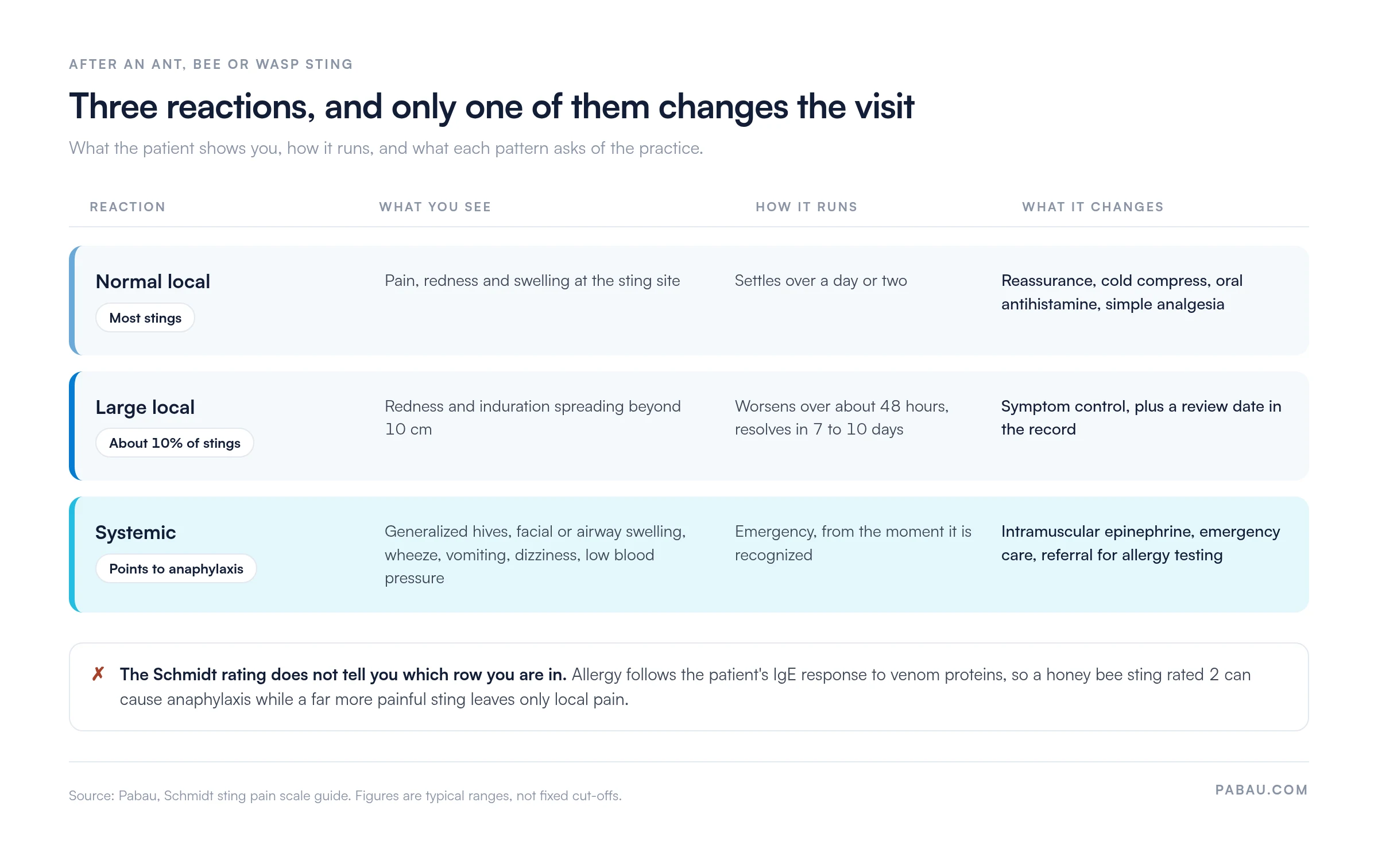
That last row is why sting pain intensity predicts none of this. An allergic reaction follows the patient’s IgE response to venom proteins, which has no connection to how much the sting hurt. A honey bee sting rated 2 can cause anaphylaxis in a sensitized patient, while a far more painful sting may leave only local pain.
Honey bees are the one common species that leaves the barbed stinger and venom sac behind. Scrape it off the skin with a card edge rather than squeezing it out with tweezers. Fatal outcomes stay uncommon, with around 62 deaths a year in the United States linked to Hymenoptera stings.
Where the ratings earn their keep in a consultation
They earn it as an expectation-setting reference. A patient stung by a paper wasp wants to know whether this much pain is normal. Schmidt’s rating and description give you a straight answer, and they give the patient language for what they felt.
Identification is the second job. Patients rarely know which insect stung them, but they can usually describe the sensation. A sting they call hot and smoky points toward a yellowjacket. One they compare to a static shock from a carpet points toward a fire ant.
Occupational exposure is where this comes up most often. Beekeepers, farm workers, foresters, landscapers, and pest control crews get stung far more often than the general population. For them the question is rarely about one sting. It is about repeated exposure and whether sensitization is building.
So record the species where the patient can name it, the circumstances, the reaction, and the treatment you gave. An allergist reading that record later can tell which venom to test for. Without it, the referral starts from a blank page.
Which practices see sting patients, and what they record
Allergy and immunology practices see the patients who have already had a systemic reaction. Sting history, species where known, and reaction severity drive testing and venom immunotherapy decisions. Those visits run on a structured note, which is what a set of allergy consultation notes is built to hold.
Urgent care and primary care practices see the acute presentations instead. Most need reassurance, a cold compress, an oral antihistamine, and simple analgesia. The clinical work is separating those from the small number that need epinephrine.
Occupational health services cover workers with routine exposure and the sensitization questions that come with it. Dermatology sees the delayed and persistent reactions, including fire ant pustules and prolonged local swelling. Travel and wilderness medicine services brief patients heading somewhere the level 4 species live.
Across all of them the pattern holds. Nobody needs a Schmidt score in the chart. They need the species, the reaction, and the follow-up recorded somewhere the next clinician will find them.
Before you close the note
Six lines cover almost every sting presentation. Run through them before the patient leaves.
- The insect, or the closest description the patient can give you
- Where on the body the sting landed, and how long ago
- The widest diameter of the reaction, measured rather than estimated
- The systemic signs you checked, including the ones that were absent
- What you gave, and what you told the patient to watch for
- The review date, and who is responsible for chasing it
The last two lines are the ones that go missing. A note that records the treatment but not the review date leaves the recall to somebody’s memory. A large local reaction takes over a week to settle.
How Pabau keeps a sting record an allergist can use
A sting presentation generates a short list of items that have to reach the patient record. They are the insect, the circumstances, the reaction and its size, the treatment given, and the review date. Handwritten notes and loose phone photos scatter that list across several places.
Most primary care teams already keep their patient files in GP practice software, so the sting record belongs there rather than on a spare sheet. Practice management software like Pabau pulls the whole presentation into one patient record.
Digital intake forms capture the sting history at check-in, so the patient fills in the circumstances before the consultation starts. Photographs of the reaction attach to the same record, which makes the 48-hour comparison straightforward.

Allergy and alert flags then stay visible on the patient’s file for every clinician who opens it. Automated recalls bring back the patients who need a review after a large local reaction. Pabau Scribe, our AI scribe, drafts the consultation note while you talk to the patient.
The outcome is a sting record another clinician can read months later, with the photographs, the flags, and the follow-up attached to it. That is what turns a single visit into something an allergist can work from.

Keep sting histories in one patient record
Pabau captures the sting history at check-in, stores reaction photographs against the same patient record, and brings the patient back for review automatically. Your team gets a record an allergist can work from, without chasing paper.

Conclusion
The Schmidt sting pain scale is a strong comparative reference and a weak clinical instrument, and both halves are worth holding onto. It tells you how much a given sting should hurt, in language patients recognize.
So use it to set expectations and to help work out what stung the patient. Keep pain scoring on the instruments built and validated for it. Triage on systemic signs, not on how much the sting hurt.
Then put what you find somewhere the next clinician will see it. Book a demo to see how Pabau holds the sting history, the photographs, and the review date in one patient record.

Continue your research
Need a plan for the next sting? Allergy action plan sets out the warning signs, the medication, and who the patient calls.
Referring on to allergy and immunology? Allergy and immunology consultation notes give the referral a structure the specialist can follow.
Capturing allergy history at intake? The food allergy form template covers triggers, past reactions, and emergency contacts on one page.
Need a validated pain scale instead? The Abbey pain scale scores pain in patients who cannot report it themselves.
Watching for a systemic reaction? The abnormal vital signs chart sets out the readings that should prompt escalation.
Frequently asked questions
Is there a level 5 on the Schmidt index?
No. The published index stops at 4, and Schmidt never added a higher band. Species that get described online as a 4+ were either rated inside the existing scale, or were never rated by Schmidt at all.
Does the scale cover spiders, scorpions, or bites?
No. It rates stings from Hymenoptera only, which means ants, bees, and wasps. Spider and scorpion envenomation sits outside it, and so do bites from mosquitoes, ticks, and other insects.
Can one insect sting a patient more than once?
Yes, with the honey bee as the exception. Its barbed stinger tears free and stays in the skin, so it stings once. Wasps, hornets, yellowjackets, and most stinging ants keep a smooth stinger and can sting repeatedly in a single encounter.
When do multiple stings become dangerous on their own?
A large number of stings can cause a toxic reaction from the venom dose alone, with no allergy involved. Children and older patients reach that point sooner. Treat a mass-sting presentation as an emergency, whatever the patient’s allergy history says.