Cervix length during pregnancy chart
A cervix length during pregnancy chart records cervical length in millimeters ag...

1
Last Updated: Oct 14, 2026
A mood and tone worksheet is a structured teaching tool that trains students to tell two literary elements apart.
Mood is the emotional atmosphere a reader experiences. Tone is the author’s expressed attitude toward the subject matter. It is built for middle and secondary school classrooms, where students develop close reading skills through guided passage analysis and word-choice exercises.
Teachers use it to move a class from passive reading comprehension into active literary interpretation. Students learn how word choice, imagery, and sentence structure combine to create emotional effect. The worksheet also works as a ready-made assessment. It measures whether a student can separate mood from tone and defend that reading with evidence from the text.
Covers mood and tone definitions, identification strategies, and reference word lists for both. It also includes passage analysis exercises with guided questions and a complete answer key.
Download template
Mood is what the reader feels, and tone is the author’s attitude toward the subject.
Students identify both from textual evidence, including word choice, imagery, sentence structure, and punctuation.
The worksheet supplies reference lists of 50 mood words and 50 tone words for students to draw on.
The answer key gives full responses and explanatory guidance, so students can self-assess and teachers can grade quickly.
Grade-level adaptations scale the same worksheet from grades 6 to 7 up through grades 9 to 10 and above.
A mood and tone worksheet gives students structured practice in one of the most commonly tested literary analysis skills in secondary education. Close attention to language is foundational to reading literature, according to the National Council of Teachers of English (NCTE). That includes noticing how an author influences reader emotion and builds a perspective. This worksheet turns that principle into a step-by-step exercise students can complete alone or with teacher support.
The resource serves two audiences. Teachers get a quick formative assessment that measures comprehension without setting an essay. Students get a framework for analyzing text, with definitions, examples, and word banks supplied, so their attention goes to interpretation rather than vocabulary.
The most common student confusion is treating mood and tone as synonyms. The table below separates them by definition, textual source, and effect on the reader.
A passage can create a joyful mood while the author’s tone is ironic. In that case the author means the opposite of what the words literally say. Teaching the distinction stops students from confusing their own reaction with the author’s intent. The Common Core State Standards (CCSS) require students at grades 6-8 to analyze how word choice affects tone. That alignment makes this worksheet a direct tool for standards-based instruction.
The worksheet follows a five-step workflow that scaffolds students from recognizing definitions to analyzing a passage on their own.
Each step carries a completed example, so students see what is expected before they attempt their own. The answer key lists several acceptable responses, because literary interpretation has a range of defensible answers when students cite the text.
Students refer to these lists to name the emotions and authorial attitudes they find in a passage. The word bank lifts the vocabulary limit, so attention stays on interpretation.
Numbering or highlighting the list on printed copies pushes students to use it while they work rather than skim it once. When a student stalls on a passage, pointing them to a specific entry redirects the analysis back to the text.
One extension activity in the worksheet connects setting to mood. Authors use details about time and place to build an emotional atmosphere. A dark, abandoned mansion reads differently from a sun-filled garden, and neither description names an emotion outright.
That is the harder half of the skill. Mood accumulates from setting, action, and imagery working together, well beyond the words that state a feeling directly.
To introduce it, have students re-read a familiar passage and underline every word describing the physical environment. Then ask what emotion that setting creates for them. The exercise shows how authors engineer mood deliberately, which moves students from spotting mood to explaining how it was built.
The worksheet fits three instructional slots, and the sections you assign change with each one.
Timing guidance: in grades 6-8, the complete worksheet takes 25 to 40 minutes. That covers all five steps plus a 4 to 5 sentence passage analysis. Grades 9-10 usually finish in 15 to 25 minutes, depending on prior familiarity.
Allow the longer estimate for a first lesson, and work through at least one passage together as a class. For independent practice after that, expect students to move faster.
Four things scale as students get older: passage length, word-bank size, the amount of scaffolding, and what the written answer has to do. The table below shows how each one moves across the three bands.
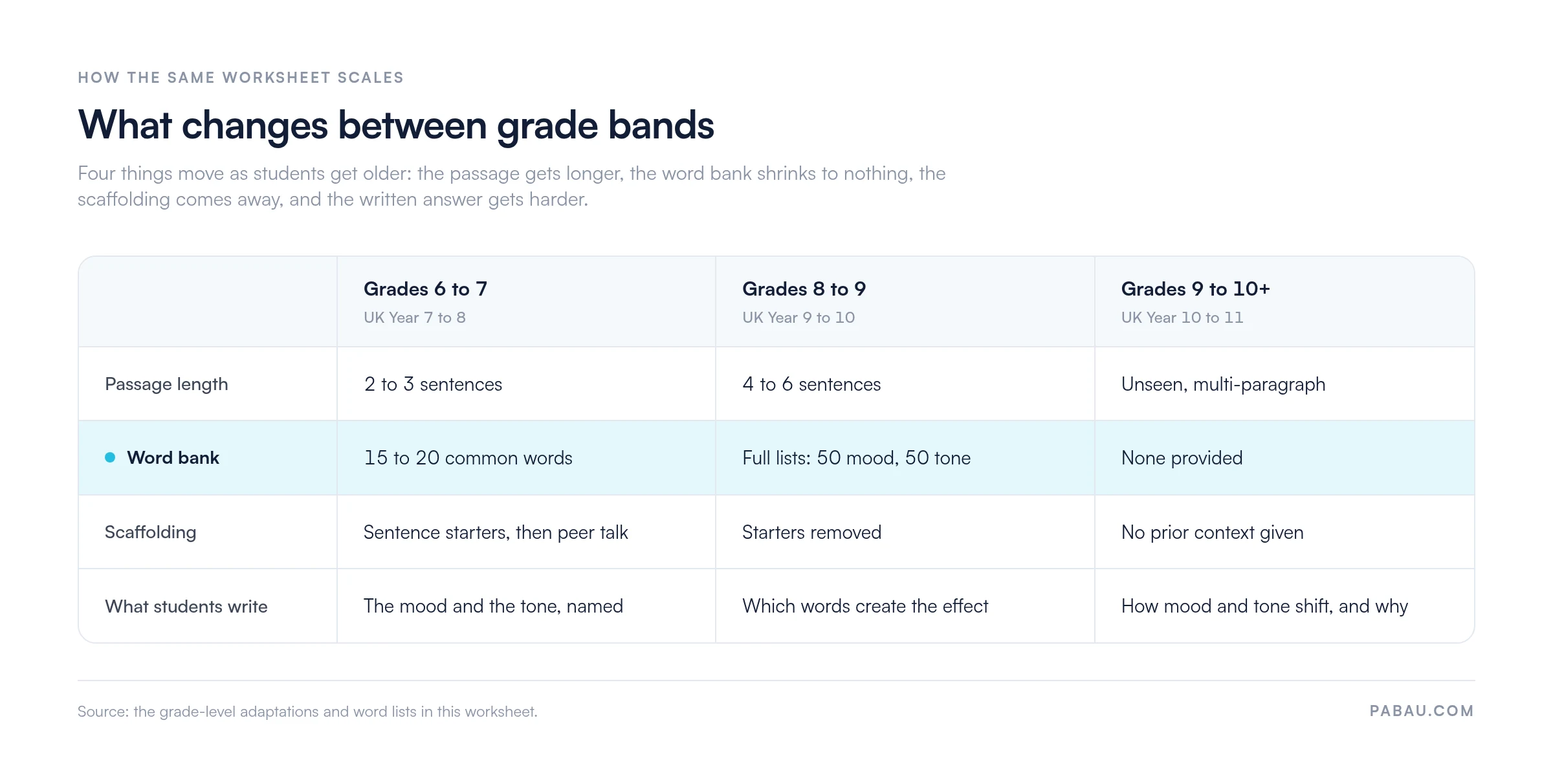
Structured worksheets are not only a classroom tool. Therapists hand patients mood logs and reflection sheets between sessions constantly, and they hit the same problem teachers do. The sheet goes out on paper, and chasing the completed copies falls to whoever has time.
Practice management software like Pabau removes that step for healthcare practices. You build the worksheet once as a digital form and send it to the patient before their appointment. The completed answers land straight on their record. No one scans, files, or re-keys the responses.
A therapist opens the patient’s record and sees the last three worksheets already sitting there, in order and dated. That is the continuity a teacher wants from a folder of completed sheets, without the folder to keep.

Pabau’s digital forms let a practice send structured worksheets before an appointment and file the completed answers on the patient record. Staff stop chasing paper and clinicians see the history in one place.

The worksheet earns its place by making an abstract distinction testable. A student who names the mood, names the tone, and points at the words behind each one has performed the analysis the standard asks for.
Start a class on the grade band below your students rather than above it. A passage that is too easy costs one lesson. A passage that is too hard teaches students that mood and tone are guesswork. Pull the scaffolding away once the first two passages come back correct.
If you run a practice rather than a classroom and hand out worksheets of your own, the same filing problem applies. Book a demo to see how Pabau sends forms to patients and files the answers on their record.
Mood is the emotional atmosphere the reader experiences. Tone is the author’s attitude toward the subject. A passage can create a hopeful mood while the author’s tone is sarcastic, meaning the opposite of the literal words. Mood answers “How does this passage make me feel?” Tone answers “What is the author’s perspective or attitude here?”
Yes. In longer passages or full texts, mood and tone often shift or layer. A sentence might create an anxious, tense mood while the author’s tone is dismissive or ironic. Advanced students track these shifts and explain how mood changes support the author’s purpose. The worksheet’s guided passages typically feature one dominant mood and tone to build foundational skills before tackling complexity.
Use the provided answer key as a guide, but accept any response that identifies a defensible mood or tone supported by textual evidence. A student who names a different but valid emotion, such as “anxious” instead of “tense”, should still receive credit. The condition is that they cite specific word choice or imagery justifying the interpretation. The goal is measuring analytical reasoning, not memorized definitions.
This page provides a free downloadable PDF worksheet with a complete answer key, word reference lists, guided practice sections, and grade-level adaptation guidance. Simply click the download button above to access the template.
The base worksheet is designed for grades 6-10 (UK Year 7-11). The grade-level adaptations section covers three bands. Grades 6-7 get simplified passages and sentence starters, grades 8-9 get reduced scaffolding, and grades 9-10+ work from unseen passages with no word banks. Teachers can adjust passage difficulty and expectations to match their students’ reading level.