CPT code 52648: Laser ablation of the prostate billing guide
What CPT code 52648 covers, and what it bundles in CPT code 52648 is the code fo...

Last Updated: Oct 21, 2026
F3400 is the CCSD code for tonsillectomy in a child, covering removal of both tonsils on a single claim line. Its official descriptor is "Tonsillectomy - child (and bilateral)", and it sits in sub-chapter 5.6.0 Throat of the CCSD schedule.
Adults take F3440 instead, and CCSD lists the two codes as an unacceptable combination. CCSD publishes no age cut-off between them, so UK private ENT practices confirm the insurer's rule at pre-authorisation. Tonsils and adenoids removed together are billed as F3480.
Let Pabau's smart automation suggest the right codes, reduce claim denials, and keep your practice compliant—effortlessly.
Automate repetitive tasks and focus on what matters most—your patients.
Reduce coding errors and ensure compliance with the latest regulations.
Clean claims, fewer denials, and faster reimbursements.
Powerful insights and reporting to help your practice thrive.
HIPAA compliant SOC 2 certified GDPR-compliant Trusted by 4,000+ clinics worldwide

CCSD Code F3400 is the child tonsillectomy code, and its single claim line covers removal of both tonsils.
Adult tonsillectomy has its own code, F3440, and CCSD lists the two codes as an unacceptable combination.
CCSD publishes no age cut-off between F3400 and F3440, so confirm the insurer’s rule for teenagers at pre-authorisation.
Tonsils and adenoids removed together are billed as F3480, never as F3400 plus the adenoidectomy code E2010.
Most UK private medical insurers require pre-authorisation before the procedure, and a missing authorisation reference is a leading denial reason.
Pabau, the practice management platform we build, carries the insurer’s authorisation code from the appointment to the F3400 claim and sends it through Healthcode.
CCSD Code F3400 is the Clinical Coding and Schedule Database code for “Tonsillectomy – child (and bilateral)”. The CCSD schedule, the procedure coding standard UK private medical insurers (PMIs) use, defines the code’s scope: one code, one claim line, both tonsils. No modifier is needed, and no second procedure code is added because both sides were removed.
F3400 sits in sub-chapter 5.6.0 Throat, alongside the adult code F3440, the adenotonsillectomy code F3480, and the intracapsular tonsillectomy code F3490. CCSD names F3400 the child code and F3440 the adult code. Its public pages set no age at which one gives way to the other. Each insurer applies CCSD codes in its own way, so the insurer decides which code a teenager takes.
F3400 is appropriate when an ENT consultant has documented a clinical indication that meets the insurer’s clinical policy. For recurrent tonsillitis, UK insurers and NHS commissioners measure episode frequency against the thresholds in SIGN guideline 117, which follow the Paradise criteria.
The four accepted indications are:
The operative note and the pre-procedure clinic letter must both reference the specific indication. Insurers deny claims when the documentation does not show a threshold that meets their clinical policy. Throat infections described in general terms, without a documented episode frequency, are not enough.
Tonsillectomy in a child is performed under general anaesthesia (GA). The patient is positioned supine with the neck extended and a Boyle-Davis gag or equivalent mouth gag inserted to expose the oropharynx. Both tonsils are removed using one of several accepted dissection techniques: cold-steel dissection, coblation, bipolar diathermy, or laser.
The choice between these techniques is clinical and does not change the code. Robot-assisted surgery has its own codes, F3441 and F3442, and an intracapsular operation is billed as F3490.
Haemostasis is achieved before closure. The child is recovered in a monitored paediatric setting and observed on the ward, with an overnight stay for younger or higher-risk children. The anaesthetist invoices the insurer separately, so the anaesthetic fee does not appear on the surgeon’s F3400 claim.
CCSD codes tonsillectomy by patient group: F3400 for a child and F3440 for an adult, each covering both tonsils. CCSD lists F3440 as an unacceptable combination with F3400, so a claim carries one code or the other.
The public CCSD pages do not set the age at which a child becomes an adult for this pair. CCSD also notes that each insurer decides how it applies the schedule’s codes. Before requesting pre-authorisation for a teenager, ask the insurer which code it expects, then quote that same code on the claim.
If the authorised code no longer fits, contact the insurer before submitting. A common case is a planned tonsillectomy that becomes an adenotonsillectomy in theatre.
No. The descriptor for CCSD Code F3400 explicitly includes “and bilateral”, so both tonsils are covered by a single code submission. Adding a bilateral modifier or a second F3400 line to show both sides were removed is incorrect. The insurer will typically query the claim or reject it as duplicate billing.
Submit F3400 once per procedure date per patient. The operative note should document that both tonsils were removed, but that documentation supports the single code. It does not call for a second code entry.
F3400 sits alongside several ENT codes that coders frequently confuse with it or pair incorrectly. Our CCSD billing guides cover other codes in the schedule in the same format.
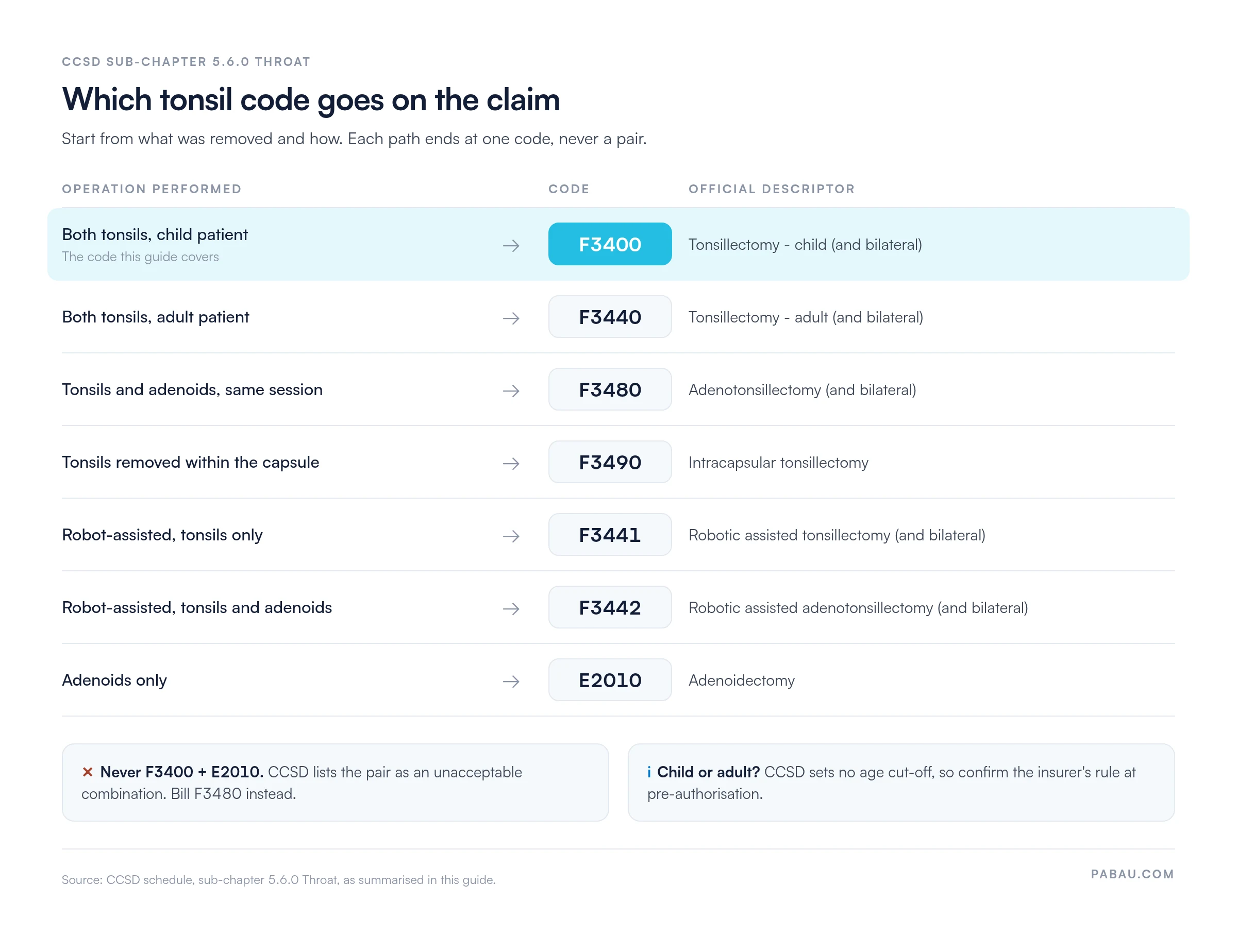
The adenoids need the most care. When a child has the tonsils and adenoids removed in one session, CCSD provides the single code F3480. The adenoidectomy code E2010 lists F3400 as an unacceptable combination, so billing the two together invites a rejection.
Insurers can still apply the schedule in their own way, so confirm the code with the insurer at pre-authorisation. The path below starts from the operation performed and ends at the one code the claim carries.
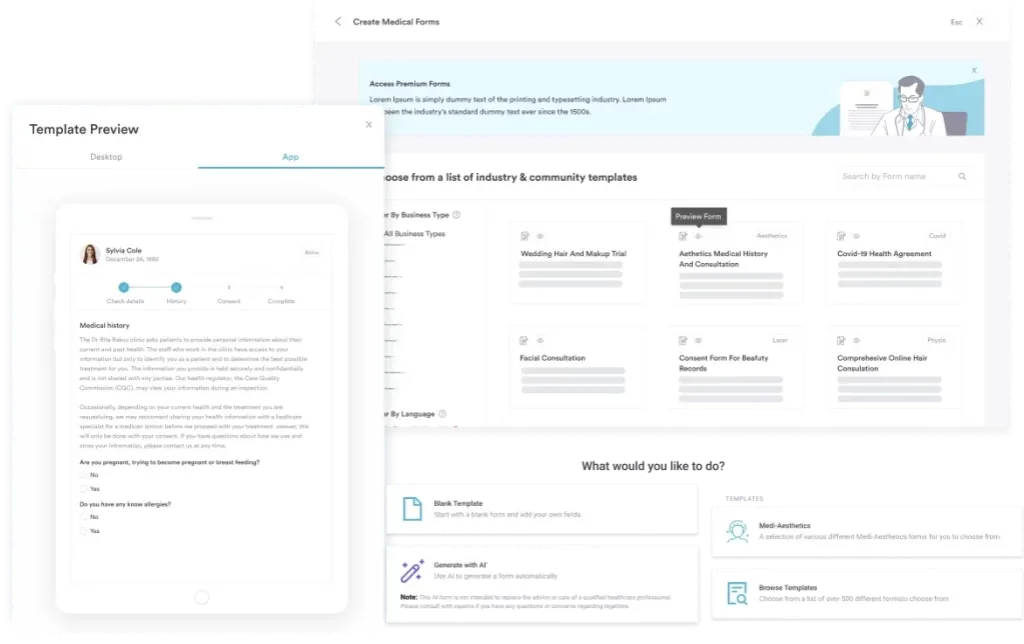
Every F3400 claim must be supported by a complete documentation set. Missing any element is a common reason claims are queried or denied.
Practices using digital clinical forms can turn this documentation set into a procedure-linked template. Every tonsillectomy episode then generates the same paperwork in the same format.
Most UK PMIs require pre-authorisation for paediatric tonsillectomy, and operating without an authorisation reference commonly leads to a denied claim. The consultant or their practice team obtains pre-authorisation before the operative date, using the proposed CCSD code (F3400) and the supporting clinical information.
Bupa assesses medical necessity against its own clinical criteria, and our Bupa CCSD code guide covers its pre-authorisation steps. AXA Health requires pre-authorisation and may request a clinical summary from the consultant before issuing approval. Aviva’s procedure fee schedule and Vitality’s fee finder both publish CCSD-coded procedure information. Practices can use them to check the code and fee band before submitting.
PMI clinical policies change annually. Treat all insurer-specific guidance here as a starting framework and verify current requirements directly with each insurer’s provider team or portal before proceeding.
Healthcode is the primary electronic billing clearinghouse for CCSD-coded claims to UK PMIs. Most private ENT practices submit invoices through the Healthcode portal or via a practice management system with an integrated Healthcode connection.
Each of the six F3400 denial causes below can be caught before the claim reaches the insurer.
Not with another tonsil or adenoid code. CCSD lists F3440, F3480, F3490 and the adenoidectomy code E2010 as unacceptable combinations with F3400. The table below sets out the pairings billing teams ask about most.
Before requesting pre-authorisation for a teenager, ask the insurer whether it expects the child code F3400 or the adult code F3440. Bupa, AXA Health and Aviva each apply CCSD codes under their own rules, so check with every insurer your patients use.
Paediatric ENT billing applies a short list of neighbouring codes to a high-volume patient group. Every F3400 claim has to line up the authorisation reference, the operative note, the date of birth and the code the insurer agreed. When that paperwork sits in separate files, a missed reference or the wrong tonsil code turns into a denial that is slow to recover.
Pabau’s claims management software stores each insurer authorisation as a case, and the authorisation code follows the appointment through to the claim. A claim with no case attached shows “Assign case”, so the team spots a missing reference before the claim goes out.
Pabau then sends the claim through Healthcode to Bupa, AXA Health, Vitality and other insurers. Each invoice is billed to the right insurer at the agreed rate, so the surgeon’s F3400 line goes out without re-keying.
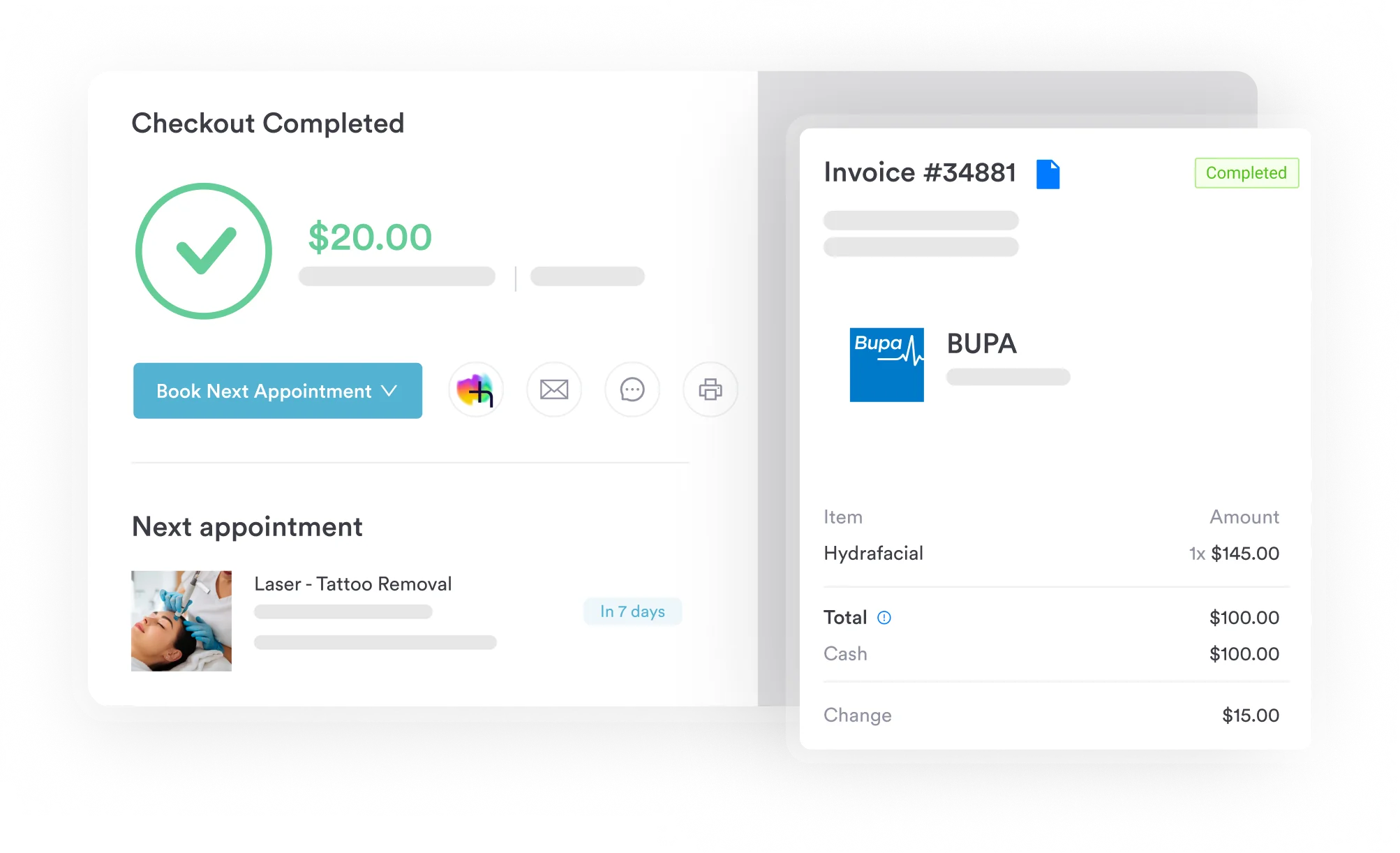

Pabau carries each insurer authorisation from the appointment to the claim, then sends it through Healthcode. Your team spends less time chasing rejected F3400 claims.

CCSD Code F3400 is a narrow code, and its avoidable rejections come from the choice between neighbouring codes rather than from the operation itself. The code agreed at pre-authorisation should be the code on the claim, because CCSD leaves the child-adult cut-off to each insurer.
For a teenager, settle F3400 or F3440 with the insurer before the operating date. If the adenoids come out too, switch the claim to F3480 rather than adding E2010. Those two checks prevent most of the queries this code attracts.
Book a demo to see how Pabau carries the authorisation code from the booking to the Healthcode claim for every tonsillectomy you bill.

Need to check Bupa’s specific CCSD billing rules? Pabau’s Bupa CCSD code guide covers Bupa’s fee schedule structure, pre-authorisation requirements, and how to submit clean claims via Healthcode.
Billing nasal surgery for the same ENT patients? CCSD Code E0412 covers reduction of nasal turbinates, with its documentation and claim submission steps.
Coding other throat procedures? CCSD Code E2330 covers removal of a parapharyngeal space lesion and how to bill it to UK insurers.
>
CCSD Code F3400 covers tonsillectomy in a child, with removal of both tonsils included in the single code. No separate code or modifier is needed to show that both tonsils were removed.
CCSD describes F3400 as the child code and F3440 as the adult code, but its public pages set no age cut-off between them. Each insurer applies CCSD codes in its own way. Confirm with the patient’s insurer which code applies to a teenager before requesting pre-authorisation.
F3400 is tonsillectomy in a child and F3440 is tonsillectomy in an adult, and both cover removal of both tonsils. CCSD lists them as an unacceptable combination, so a claim carries one or the other. Robot-assisted tonsillectomy has its own code, F3441.
No. F3400 covers the tonsils only. When the adenoids come out in the same session, CCSD provides the combined code F3480 (adenotonsillectomy) instead. Do not add the adenoidectomy code E2010 to F3400, because CCSD lists the pair as an unacceptable combination.
Major UK private medical insurers generally require pre-authorisation before paediatric tonsillectomy, and claims without an authorisation reference are usually rejected. Verify current pre-authorisation requirements directly with each insurer before booking the procedure.
Leading denial reasons are missing pre-authorisation, the child code used where the insurer expects the adult code F3440, and thin clinical justification. Billing E2010 alongside F3400 instead of F3480 and a missing signed operative note also cause rejections.