CPT code 48152: Whipple procedure without pancreatojejunostomy
CPT code 48152: Official description and procedure overview CPT code 48152 descr...

Last Updated: Nov 13, 2026
20220 is the CCSD code for a pure tone audiogram that measures both air conduction and bone conduction hearing thresholds, with masking included. The published descriptor reads "Pure tone audiogram (air and bone conduction) - including masking."
Comparing the two sets of thresholds shows whether a hearing loss is conductive, sensorineural or mixed. An audiogram that tests air conduction only takes 20210 instead, and an impedance audiogram is billed as 20230.
Let Pabau's smart automation suggest the right codes, reduce claim denials, and keep your practice compliant—effortlessly.
Automate repetitive tasks and focus on what matters most—your patients.
Reduce coding errors and ensure compliance with the latest regulations.
Clean claims, fewer denials, and faster reimbursements.
Powerful insights and reporting to help your practice thrive.
HIPAA compliant SOC 2 certified GDPR-compliant Trusted by 4,000+ clinics worldwide

CCSD code 20220 covers a pure tone audiogram that tests both air conduction and bone conduction, with masking included in the code.
An audiogram that tests air conduction only is billed as 20210, and an impedance audiogram is billed as 20230 or 20240.
The audiogram form should show air and bone conduction thresholds for each ear, plus which thresholds were masked.
Insurers set their own maximum for 20220: The Exeter lists £50 and Allianz Care’s UK schedule lists £70.
Check CCSD’s unacceptable combinations and the insurer’s authorization rules before adding a second code to the same invoice.
CCSD code 20220 is the UK private insurance code for a pure tone audiogram that measures air conduction and bone conduction thresholds, with masking included.
The Exeter’s published fee schedule lists it as “Pure tone audiogram (air and bone conduction) – including masking.”
The Clinical Coding and Schedule Development group (CCSD) maintains the procedure schedule that UK private medical insurers use. Its technical guide places five-number investigation codes like 20220 in Chapter 1 of the procedural schedule. Some codes also sit in the diagnostic schedule, and CCSD files 20220 under Chapter 30, Audiology diagnostic.
Our CCSD code library collects billing guides for other codes in the schedule, including the audiology codes either side of 20220.
The descriptor names three components, and the audiogram has to show all three to support the code:
The British Society of Audiology’s recommended procedure sets the standard method for both parts of the test. Air conduction comes first. The audiologist starts with the better-hearing ear at 1000 Hz, then tests 2000, 4000, 8000, 500 and 250 Hz.
Bone conduction follows, normally only between 500 Hz and 2000 Hz. Comparing the bone conduction thresholds with the air conduction thresholds shows whether a hearing loss is conductive, sensorineural or mixed. That comparison is the clinical reason to perform 20220 rather than an air-conduction-only test.
The BSA procedure sets two rules for when the audiologist must mask the non-test ear:
Four audiometry codes sit side by side in the schedule, and each descriptor names the components it covers. The matrix shows which code matches which test.
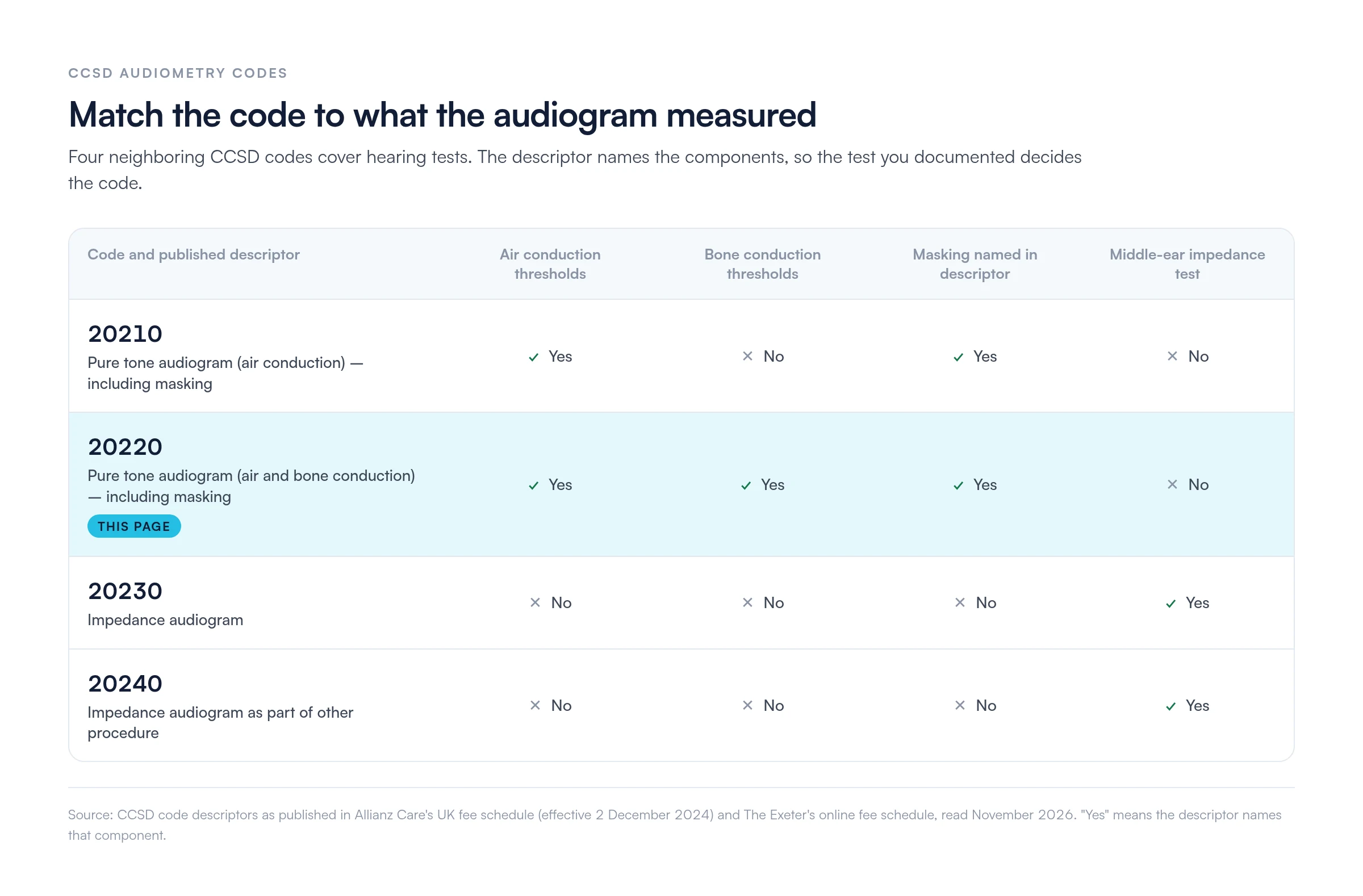
The impedance codes cover a different test entirely. Code 20230 is an impedance audiogram on its own, while 20240 covers an impedance audiogram performed as part of another procedure.
Use the test you documented to pick the code:
CCSD records unacceptable combinations, pairs of codes that should not be billed together, against each code on its website. The schedule search sits behind a CCSD login, so check the entry for 20220 before you add a second audiology code to an invoice.
The record has to show the components the descriptor names. Following the BSA procedure’s recording rules, keep these on file for every 20220 claim:
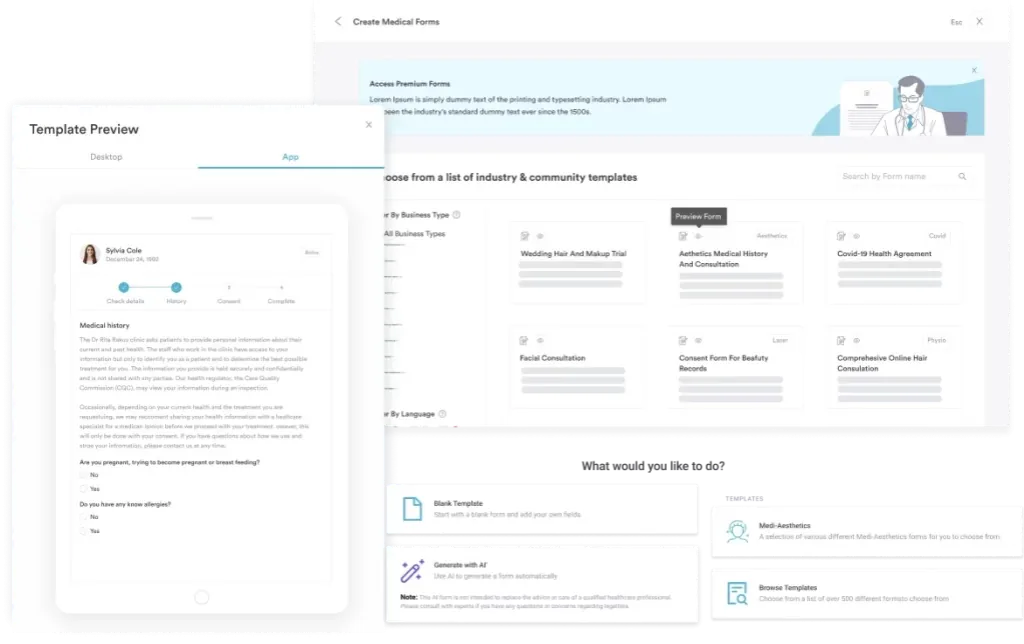
A structured audiogram form makes each item a field the audiologist completes during the test, rather than a note added afterward.
Each insurer sets its own maximum benefit for 20220, so the fee depends on the patient’s policy. The Exeter lists £50 for the procedure and £0 for anesthesia. Allianz Care’s UK fee schedule, effective 2 December 2024, lists £70 for both 20210 and 20220.
The Exeter asks members to get the CCSD code from their specialist, then call to authorize the claim before any treatment. Other insurers set their own authorization rules, so confirm them with each one before the appointment.
Bupa publishes its codes through its code search tool. Our guide to Bupa CCSD codes explains how its schedule works, and the Bupa fee schedule guide covers how Bupa sets reference fees.
A 20220 claim draws on three records: the audiogram, the authorization and the invoice. When each lives in a different tool, the team rebuilds the link between them for every claim.
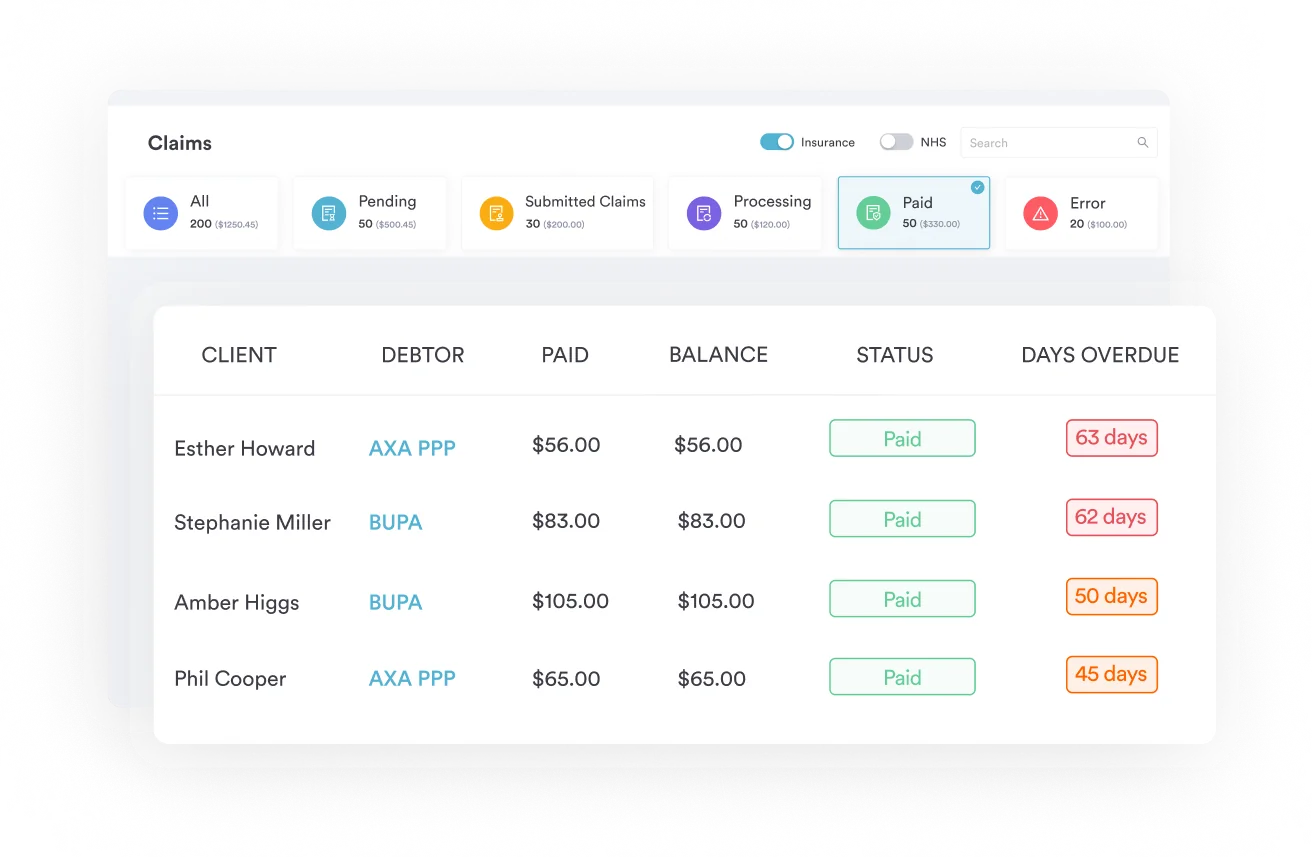
Pabau, the practice management platform we build, keeps all three on the patient record. Its claims management software sends UK claims through Healthcode and Bupa, and the claims dashboard tracks each one to payment.
The authorization code, its dates and the sessions it covers are tracked on the patient case. Pabau warns you when an authorization is missing, so you can catch it before the patient is tested.

Pabau keeps audiogram forms, authorization codes and insurer claims on one patient record, so your team submits 20220 claims with the evidence already attached.

Bill 20220 only when the audiogram measured bone conduction as well as air conduction. If bone conduction was not tested, 20210 is the accurate code, and an impedance test belongs under 20230 or 20240.
Before you submit, check the insurer’s authorization rules and CCSD’s unacceptable combinations for 20220. That check takes minutes, while a returned claim costs a resubmission and a later payment. Book a demo to see how Pabau keeps audiogram records, authorizations and claims together for your audiology practice.

Billing an impedance audiogram on its own? CCSD code 20230 covers the standalone impedance audiogram and what to record for it.
Impedance test done during another procedure? CCSD code 20240 explains when the in-procedure impedance code applies.
Working with Bupa patients? Bupa CCSD codes explains how the Bupa code schedule works for private providers.
Need Bupa’s reference fees? Bupa procedure codes fee schedule covers how Bupa sets reference fees before you invoice.
CCSD code 20220 covers a pure tone audiogram that measures air conduction and bone conduction hearing thresholds, with masking included. Its published descriptor is “Pure tone audiogram (air and bone conduction) – including masking.”
Code 20210 covers a pure tone audiogram with air conduction only, while 20220 adds bone conduction. Both descriptors include masking, so masking never decides between them.
No. The 20220 descriptor already includes masking, so it is part of the code. Record which thresholds were masked so the audiogram supports the descriptor.
Only if CCSD’s unacceptable combinations for 20220 and the insurer’s own rules allow it. Check the 20220 entry on the CCSD website before adding 20230 to the same invoice.
The Exeter’s fee schedule lists a £50 maximum for 20220, and Allianz Care’s UK schedule, effective 2 December 2024, lists £70. Other insurers set their own figures.
CCSD files 20220 under Chapter 30, Audiology diagnostic, in its diagnostic schedule. As a five-number investigation code, it also belongs to Chapter 1 of the procedural schedule.