



Key takeaways
Weight Watchers is a points-based program that gives every food a point value. Each person gets a daily points budget set by their weight, height, age, and activity level.
The PersonalPoints formula scores food on calories, saturated fat, and added sugar, then subtracts a credit for protein. Lean proteins, most fruits, and non-starchy vegetables usually score zero.
Unused points roll over at up to four a day, capped at 28 a week. Those are the patient’s own points carried forward, not a separate allowance.
A structured 7-day plan removes the daily decision. The version below averages 15.4 points a day, which leaves room for a meal out.
Practices hand this template to patients to guide meal planning, portion control, and tracking. Share it through the patient portal or during the consultation.
Download your free Weight Watchers diet plan
Seven days of meals with a point total for each day, plus a zero-point foods list. It also carries a matching grocery checklist and space to log the weekly weigh-in.
Download templateA structured Weight Watchers diet plan gives patients a flexible points budget instead of a calorie count to police. This guide sets out how to run a 7-day plan in practice. It explains what the PersonalPoints formula scores, where patients lose track, and hands you a template they can print and follow at home.
What is a Weight Watchers diet plan?
A Weight Watchers diet plan gives every food a point value and every patient a daily budget to spend. It is a commercial weight loss program built around flexible eating rather than elimination. Patients who do better with firm rules often switch to a paleo diet plan instead.
The brand name has moved twice. Weight Watchers shortened to WW in 2018, then returned to the full WeightWatchers identity across 2024 and 2025. Patients will arrive using all three names, and they all describe the same program.
The current PersonalPoints formula scores a food on its calories, saturated fat, and added sugar, then subtracts a credit for protein. Carbohydrate and fiber are not direct inputs. Fiber matters in only one place, where it helps decide which foods qualify as zero-point.
For patients, the appeal is the arithmetic. They track points instead of memorizing calorie totals, and they can still fit the foods they like into a day. That shift in framing is what keeps the tracking habit alive when motivation dips.
How does the points system work?
The WW app sets each person’s daily budget from age, height, weight, biological sex, and activity level. A 55-year-old office worker and a 30-year-old fitness coach therefore get different allowances.
- Daily points budget: Usually 20 to 30 points, depending on those inputs. The WW app calculates it during onboarding.
- Rollover points: Up to four unused points a day carry forward, capped at 28 across the week. These come out of the patient’s own budget, so a light Tuesday funds a restaurant Friday.
- Point values: A 3 oz grilled chicken breast is 0 points and a slice of whole wheat bread is 2 points. A tablespoon of peanut butter is 4 points.
- Tracking method: Patients log meals in the WW app or a paper journal. The app counts as they go and flags them as they near the daily limit.
The system teaches portion awareness without daily calorie math. A patient learns quickly which foods deliver nutrition cheaply and which are indulgences, then trades between them on purpose.
Zero-point foods you can eat freely
Zero-point foods do not count against the daily budget. That takes the anxiety out of a second helping of broccoli or a third apple.
- Proteins: Chicken breast (skinless), turkey, lean ground beef, eggs, Greek yogurt (fat-free or low-fat), tuna (canned in water), cod, tilapia.
- Vegetables: Broccoli, spinach, carrots, peppers, tomatoes, cucumbers, zucchini, asparagus, green beans (fresh or frozen, no added oil).
- Fruits: Apples, oranges, strawberries, blueberries, watermelon, grapefruit. Most fresh fruits score zero, but dried fruits and juices do not.
- Legumes: Beans (black, kidney, chickpea), lentils, split peas, all cooked without oil.
WW updates the zero-point list periodically. Ask patients to check the current version in the app or on weightwatchers.com before they shop.
Your 7-day meal plan, day by day
A 7-day Weight Watchers meal plan takes the daily decision away by pre-scoring breakfast, lunch, dinner, and a snack. The version below assumes a 25-point daily budget, so adjust portions for patients on a smaller one.
Notice how much room the week leaves. No day in the plan spends more than 19 of the 25 points, which is what makes an unplanned dinner out survivable.
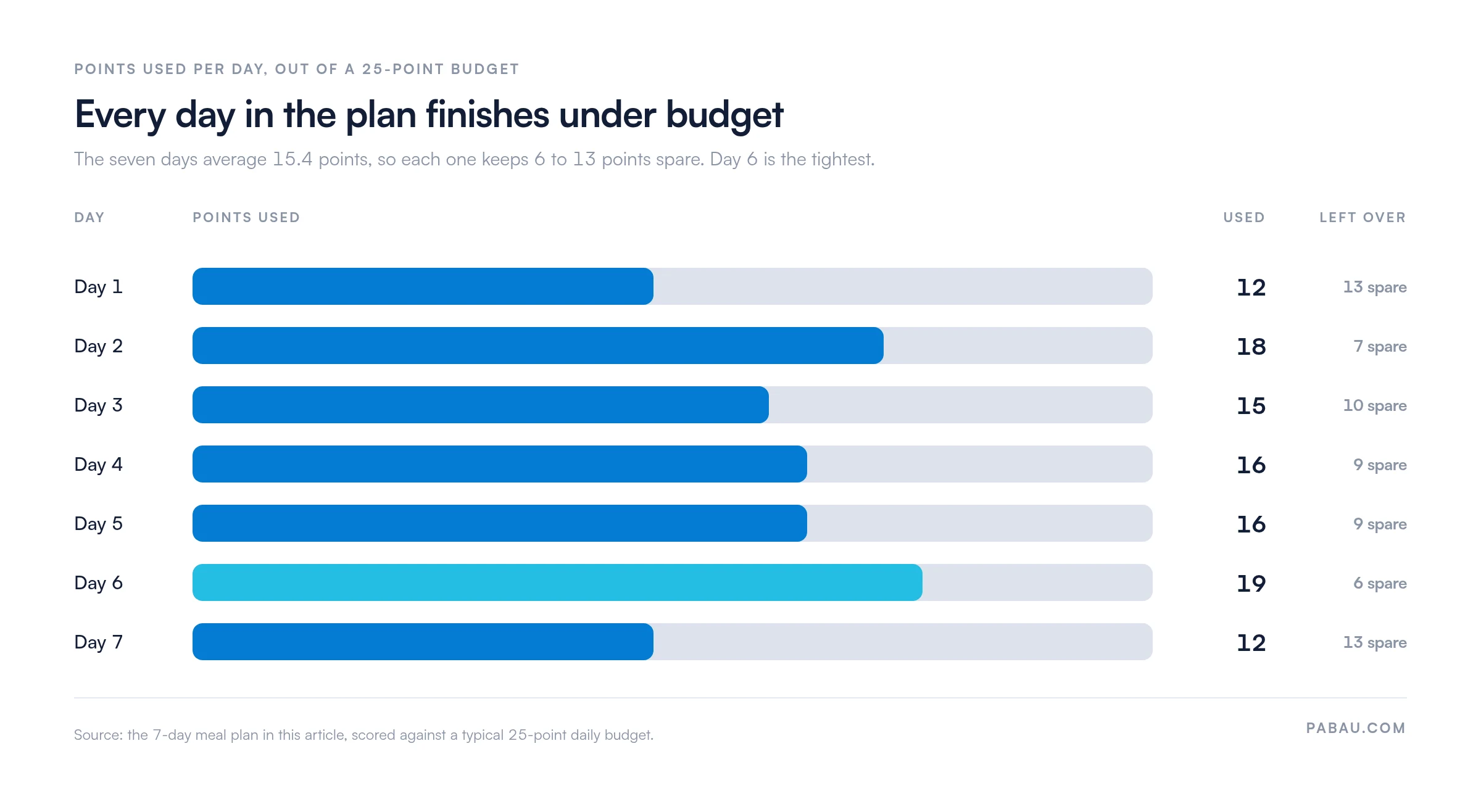
Day 1: Scrambled eggs with toast (5 pts), then a grilled chicken salad (3 pts). Dinner is baked salmon with roasted vegetables (4 pts), with Greek yogurt and berries as a snack (0 pts). Daily total: 12 points.
Day 2: Oatmeal with banana (4 pts), then a turkey and tomato sandwich (6 pts). Dinner is a lean beef stir-fry with brown rice (5 pts), with apple and almond butter as a snack (3 pts). Daily total: 18 points.
Day 3: Greek yogurt with granola (4 pts), then tuna salad with crackers (5 pts). Dinner is chicken breast with sweet potato (4 pts), with cottage cheese and pineapple as a snack (2 pts). Daily total: 15 points.
Day 4: Whole wheat pancakes with maple syrup (6 pts), then lentil soup (3 pts). Dinner is pork tenderloin with broccoli (4 pts), with string cheese and grapes as a snack (3 pts). Daily total: 16 points.
Day 5: Veggie omelet with whole grain toast (5 pts), then chickpea curry with rice (5 pts). Dinner is grilled cod with asparagus (2 pts), with a protein bar as a snack (4 pts). Daily total: 16 points.
Day 6: Yogurt parfait with granola (5 pts), then a chicken Caesar wrap (6 pts). Dinner is turkey meatballs with pasta (5 pts), with an orange and almonds as a snack (3 pts). Daily total: 19 points.
Day 7: Breakfast burrito with eggs and cheese (6 pts), then minestrone soup (2 pts). Dinner is baked tilapia with quinoa (4 pts), with mixed berries as a snack (0 pts). Daily total: 12 points.
Grocery shopping list for the week
A printable list matched to the seven days keeps patients out of the aisles they do not need. It also keeps the impulse buys that wreck a points budget out of the cart.
- Proteins: Chicken breast, ground turkey, salmon fillets, cod, tilapia, eggs, Greek yogurt, cottage cheese, low-fat milk.
- Vegetables: Spinach, broccoli, carrots, bell peppers, tomatoes, zucchini, asparagus, green beans (fresh and frozen).
- Fruits: Apples, oranges, strawberries, blueberries, bananas, watermelon, pineapple (fresh).
- Grains and starches: Whole wheat bread, brown rice, oats, sweet potatoes, quinoa, whole grain crackers.
- Pantry staples: Olive oil, low-sodium vegetable broth, canned tomatoes, beans (black, kidney, chickpea), lentils, and spices such as garlic powder, paprika, and cumin.
- Condiments: Low-calorie salad dressing, mustard, reduced-fat peanut butter (measured portions).
Meal prep tips to make the plan easier
Meal prep is what carries the plan through a busy work week. Patients who batch-cook proteins, chop vegetables, and portion snacks on Sunday stay on plan far more often.
- Prep proteins in bulk: Grill three or four chicken breasts, roast a tray of salmon, boil eggs, or brown a pound of ground turkey. Store the portions in glass containers and reheat them through the week.
- Chop and store vegetables: Wash and chop broccoli, carrots, bell peppers, and spinach, then store them in airtight containers. Vegetables that are ready to eat remove the excuse to grab a convenience food.
- Cook grains in batches: Make a large pot of brown rice or quinoa and portion it into containers. It reheats as a side dish or goes into a salad cold.
- Build grab-and-go snack boxes: Pre-portion Greek yogurt, berries, almonds, cheese, and crackers into single servings. Patients then stop eating straight from the bulk container.
- Label each container with its point value: Write the number on the lid. That removes the arithmetic at the moment a patient is hungry and tired after work.
How to track your points effectively
Tracking is where the plan is usually won or lost. Patients slip in three predictable ways. They underestimate portions, forget to log snacks, and stop logging at the weekend. Name all three at the first consultation so nobody is caught out by them.
Use the app, not memory: The WW app carries a database of more than 100,000 foods with verified point values. Paper tracking invites guessing and rounding down.
Ask patients to log a meal as they eat it rather than at bedtime. Then they know what is left and can plan dinner around it. Logging usually turns automatic inside two or three weeks.
Measure portions for the first week: Give patients a kitchen scale and a set of measuring cups. A serving of cooked rice is half a cup, not the full cup most people plate up. Once they can picture half a cup, restaurant estimates get much closer.
Log the weekly weigh-in the same day: The app plots the trend over time, and the trend is the number that matters. Weigh in on the same day, at the same time, once a week. A midweek gain of two or three pounds is a signal to tighten tracking, not to skip meals.
Snack ideas that fit the points budget
Snacks hold a patient between meals so they do not arrive at dinner ravenous. Protein and fiber buy the most satiety per point.
- Zero or low-point snacks: An apple, berries, a grilled chicken drumstick, an egg white, or carrot sticks with hummus (2 pts). Fat-free Greek yogurt is 0 pts and roasted chickpeas are 3 pts per serving.
- Moderate-point snacks: String cheese is 1 pt and a handful of almonds is 3 pts. A protein bar runs 3 to 4 pts, and popcorn with light seasoning is 2 pts per cup.
- Avoid or limit: Flavored yogurts, which carry a lot of added sugar. Granola bars often run past 4 pts with little fiber, and full-fat cheese and high-point crackers go the same way.
Tips for staying on track
Long-term adherence comes from planning, not willpower. Help patients decide in advance what they will do in the situations that usually end a points week early.
- Plan the week before it starts: Ask patients to spend 20 minutes each Sunday choosing meals and writing the grocery list. A decided week takes far less willpower than an undecided one.
- Spend rollover points on purpose: A restaurant dinner or a birthday is easier to fund from four light days beforehand. Banking points beats skipping breakfast to make room afterwards.
- Keep two zero-point meals ready in the fridge: Cooked chicken and chopped vegetables are enough. A late, tired evening then becomes a 10-minute dinner instead of a takeout order.
- Recover the same day, not next Monday: One over-budget day changes very little on its own. Tell patients to log it honestly and eat normally at the next meal.
- Weigh in on the same day each week: One number, taken under the same conditions, shows the trend. Daily weighing mostly shows water weight and discourages people.
- Book the follow-up before the patient leaves: Adherence usually slips around week three. An appointment already in the calendar catches that slip while it is small.
Ask each patient which of these they expect to find hardest, then write the answer in their record. The next consultation can start from what they told you rather than a general reminder to keep tracking.
How Pabau helps you deliver and track the plan
Practice management software like Pabau turns the points plan from an emailed PDF into a documented part of care. Digital intake forms collect weight, medical history, and food preferences before the first consultation. The plan then goes out through our online booking portal, so every patient holds one current version.
Weekly weigh-ins, point totals, and adherence notes sit in the same record as your consultation notes. When a patient stalls in week three, you can see which week the logging stopped. Automated email and SMS reminders prompt patients to log meals and book the next weigh-in.
Every Pabau subscription includes the forms, the portal, the records, and the reminders. Structured onboarding sets the workflow up once, and it then runs for every patient you start on the plan.

Deliver WW plans and track every weigh-in
Pabau’s digital forms, patient portal, and automated reminders send the points plan out and record how each patient responds. Weights and adherence notes stay in one record, with no extra admin for your front desk.

Conclusion
The points system handles the arithmetic. What decides whether a patient reaches month three is the screening you do on day one and the check-ins you book after it.
Set the daily budget, teach portions with a kitchen scale in week one, and agree how the weekly weigh-in will happen. Then record what changes each week. That record tells you whether to adjust the budget or change the approach entirely.
Book a demo to see how Pabau distributes diet plans and keeps weight-loss progress in one patient record.

Continue your research
Want a plan with no points math? Healthy meal plan gives patients a balanced weekly framework built on portions instead of scoring.
Patient focused on protein? High protein meal plan helps patients hold muscle while they lose weight.
Tracking macros rather than points? Macro diet plan sets out protein, carb, and fat splits patients can follow.
Need something to mark weekly progress? Weight loss reward chart turns each week on plan into a visible win.
Managing blood pressure alongside weight? DASH diet plan covers the sodium and potassium targets a points plan leaves out.
Frequently asked questions
How does the Weight Watchers point system work?
The PersonalPoints formula scores each food on its calories, saturated fat, and added sugar, then subtracts a credit for protein. Carbohydrate and fiber are not direct inputs, though fiber helps decide which foods qualify as zero-point. The WW app sets a personal daily budget from age, weight, height, biological sex, and activity level. Patients log meals and stay inside that budget, which creates the calorie deficit that drives weight loss.
What foods are zero points on WW?
Zero-point foods include most lean proteins, such as chicken breast, egg whites, tilapia, and Greek yogurt. Non-starchy vegetables and many fresh fruits also score zero. The list varies by WW plan and changes periodically, so ask patients to check the current version in the WW app.
How many WW points can I have per day?
Daily budgets usually fall between 20 and 30 points, and the WW app calculates yours at signup from your own details. Up to four unused points a day roll over, capped at 28 across the week. That rollover comes out of your own daily budget rather than a separate weekly allowance.
Is Weight Watchers effective for long-term weight loss?
Research in peer-reviewed journals shows WW participants lose 5 to 10% of body weight within six months. That result assumes the program is paired with behavioral coaching. Long-term success depends on consistent tracking, community engagement, and treating the plan as a way of eating rather than a temporary diet. Individual outcomes vary with adherence and underlying metabolic factors.
Can I do Weight Watchers without a membership?
WW requires a paid membership for the app, the coaching, and a personalized point budget. Practitioners can still hand patients a printed template like this one, which teaches the core principles. Patients can then join WW themselves or work through the template with you.
How do I create a Weight Watchers grocery list?
Start with protein sources such as chicken, fish, eggs, and yogurt, then add non-starchy vegetables. Fill in fruits, whole grains, and low-point pantry staples like olive oil, spices, and canned beans. Group the list by store section to speed up the trip. Write the point value next to each item so you can build meals in the aisle instead of guessing.